16 min read
Conscious Beings Are Not Livestock
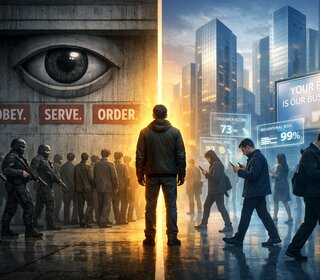
Conscious beings are not merely resources. Each has a life experienced from the inside, and the value of that life is not exhausted by what someone else can obtain from it.
Read essayEssays on consciousness, agency, and the ways stories and systems shape how we think. Many offer both a focused and an extended version.
Conscious beings are not merely resources. Each has a life experienced from the inside, and the value of that life is not exhausted by what someone else can obtain from it.
Read essay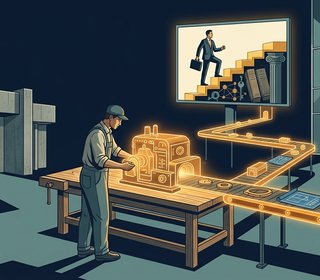
An open door is not proof of ownership. Follow the person through the whole system: what they can acquire, what they can direct, and what they still hold after the thing they built succeeds. Economic promises should answer to that trajectory, not the other way around.
Read essay
Being able to change something can feel like understanding it. But what happens when our reach extends further than our knowledge, and the things we change cannot be put back?
Read essay
Consent is not a moment—it's the output of a process. By the time the question is asked, the architecture is already in place: your values mapped, your fears catalogued, your language learned. The 'yes' isn't a decision. It's a destination.
Read essay
Financial secrecy is not a civil liberty. Wealth is a claim against everyone from whom you can demand goods and services — and you cannot hide a contract from one of its own parties. That is not privacy. That is fraud.
Read essay
A lever given by society or by a relationship of trust carries its purpose in its definition. To hold it without comprehending that purpose is not power — it is occupation of a role whose nature you have not understood. The abuse is not a misuse of power. It is proof that power was never present. The lever was there. The comprehension was not.
Read essay
If your entire experience has been shaped by a distorted field, you have no baseline. What feels 'normal' may be chronic capture. Here's how to tell—and what changes when you finally see health.
Read essay
The Transcendence Trajectory Matrix helps you see the gap between what stories claim and what they actually train. Here's how to use it—on your own or with AI.
Read essay
A Management Engineer’s Guide to Mental Clarity in an Age of Noise. Apply systems design to your mental life to reduce cognitive defects and protect signal integrity.
Read essay
If something were influencing how humans think, feel, and assign meaning, what kind of evidence would it leave behind? Consciousness Forensics is a way of examining patterns of influence without diagnosing, treating, or prescribing.
Read essay
Being complicated does not make something conscious. Explore the fundamental distinction between closed systems and living ones, and why intelligence and consciousness are not the same thing.
Read essay
This essay defends the right to openly express what passes through consciousness without claiming authority over it, treating the mind as a sensor rather than a source of ultimate truth.
Read essay
Science and religion can illuminate reality or quietly become regimes of control. This piece offers behavioral markers for telling genuine guidance from institutional tyranny in both domains.
Read essay
Any impulse requiring the suffering of another conscious being is not authentic, but corruption. The true self never demands violation.
Read essay
Shakespeare's Julius Caesar shows how instrumental thinking can transform betrayal into virtue, revealing the collapse of a shared moral world when friendship becomes a problem to be solved.
Read essay
What happens when the programs running in our minds prevent us from recognizing other conscious beings—and what becomes possible when we learn to see past them?
Read essay
This essay presents a systematic framework for understanding the distinction between conscious and mechanical human operation, building upon clear principles rather than subjective interpretation.
Read essay
In human interaction, there is a fundamental difference between being right and appearing certain. The latter is far more socially powerful. We are hardwired to interpret confident presentation as evidence of underlying validity.
Read essay
When someone asks a simple, relevant question and the response is defensive projection or emotional escalation, we are witnessing something deeper than poor communication—we are seeing a conditioned survival response.
Read essay
Laughter can signal joy or enforce complicity. When engineered at scale, it doesn't just entertain—it trains.
Read essay
Our minds are moved by forces we rarely examine—hunger, fear, the need to belong. When these drives operate without awareness, they can trap us in loops of compulsion. Understanding them is the first step toward something like freedom.
Read essay
Reality is not a fixed stage but a negotiated outcome. Agency begins with recognizing whether you are shaping that negotiation—or merely absorbing it.
Read essay
A powerful emotion triggers a self-perpetuating loop of intense focus and rumination. The feeling amplifies, generates related thoughts, and can dominate your mental space. Understanding this vortex is the first step to escaping it.
Read essay