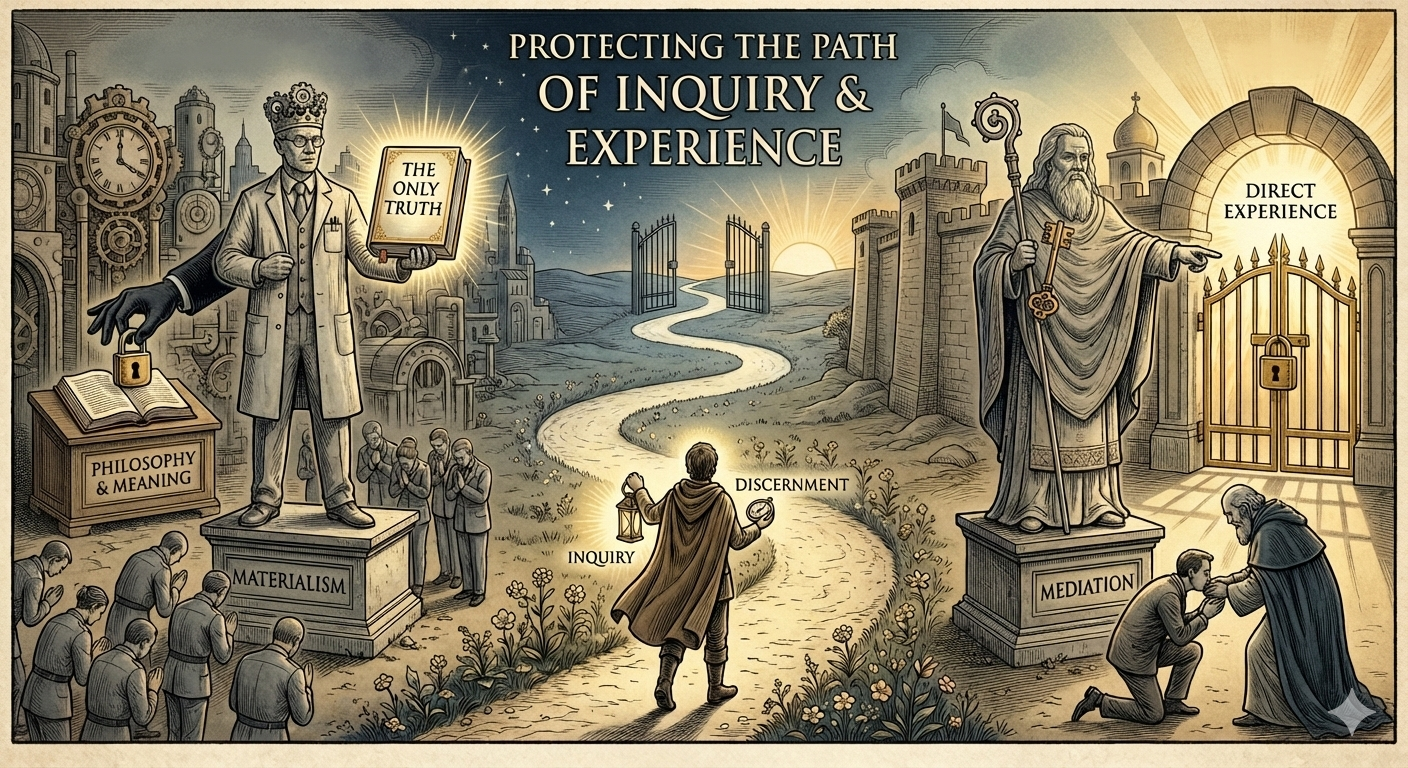
Protecting Science from Scientism — and God from Religious Tyranny: Identifying Institutional Overreach

Drawing on philosophy of science and sociology of knowledge, this article proposes criteria for identifying when institutions shift from enabling inquiry and connection to exercising coercive authority—distinguishing science from scientism and spiritual guidance from religious tyranny.

Abstract

Modern science and institutionalized religion function as major frameworks through which societies organize knowledge, meaning, and authority. This article does not dispute the legitimacy or value of these institutions. Instead, it proposes a set of analytically grounded criteria for identifying when institutions shift from enabling inquiry and connection to exercising coercive or exclusionary authority. Drawing on philosophy of science, sociology of knowledge, and historical analysis, the article distinguishes science as a methodological practice from scientism as epistemic overreach, and spiritual guidance from religious tyranny as monopolization of access to transcendence. The central claim is that institutional tyranny is identifiable not by doctrinal content but by observable behavioral patterns: language of certainty beyond method, suppression of questioning, enforced mediation, and jurisdictional expansion beyond legitimate domains.


1. Methodological Note

This article does not evaluate the truth or falsity of scientific theories, metaphysical positions, or theological doctrines. Instead, it examines institutional behavior and epistemic posture. The analysis operates within established traditions in the sociology of knowledge and philosophy of science, where authority, legitimacy, and boundary maintenance are treated as social phenomena rather than purely logical outcomes. Claims are assessed based on how institutions relate to inquiry, uncertainty, dissent, and individual verification, rather than on the substantive conclusions they endorse.

It should be emphasized that this critique targets tyrannical patterns, not religious institutions per se. Many religious communities function as genuine guides that respect individual spiritual autonomy. The concern is with specific behaviors that convert guidance into control, regardless of which tradition exhibits them.


2. The Core Distinction: Institutional Service vs. Institutional Overreach

Institutions arise to preserve knowledge, coordinate collaboration, and transmit practices across generations. Their legitimacy depends on whether they continue to serve these enabling functions or evolve into mechanisms of domination.

Institutional overreach is not defined by intent but by behavior. Historically, institutions that exercise epistemic or spiritual authority consistently present themselves as benevolent. Therefore, analytical distinction must rely on observable markers rather than stated aims.

The guiding question is simple: Does the institution enable individual verification and inquiry, or does it demand submission to its authority?


3. Science and Its Original Epistemic Commitments

3.1 Science as Methodological Practice

Science emerged as a disciplined method for investigating observable phenomena through reproducibility, public reasoning, and methodological transparency. Its foundational norm can be summarized as: given the same conditions, independent investigators should obtain comparable results. Classical formulations of scientific practice emphasize provisional conclusions, fallibility, and openness to revision.

Sociologist Robert K. Merton famously articulated normative commitments of science—including communalism, universalism, disinterestedness, and organized skepticism—which frame science as a self-correcting enterprise rather than a source of ultimate authority.

Example: When scientists publish findings on climate patterns, they provide data sets, methodological protocols, and statistical analyses so that other researchers can replicate or challenge their work. This transparency reflects science’s commitment to collective verification rather than appeals to authority.

3.2 The Institutionalization of Science

During the nineteenth and twentieth centuries, science underwent extensive professionalization and institutionalization. Universities, funding agencies, peer-review systems, and disciplinary hierarchies transformed science from a distributed practice into a centralized authority structure. Scholars of scientization describe this process as the expansion of scientific norms and legitimacy into governance, education, and cultural identity.

Jerome Ravetz characterized this transformation as the rise of “industrialized science,” wherein institutional incentives—such as funding competition, publication metrics, and reputational pressures—shape epistemic behavior. Under these conditions, incentives often favor certainty, authority, and consensus over exploratory humility.


4. Scientism as Epistemic Overreach

Scientism is not science. It is the extension of scientific authority beyond its methodological jurisdiction into comprehensive metaphysical claims presented as empirical necessity.

Philosophers of science distinguish legitimate empirical inference from philosophical interpretation. Scientism emerges when this distinction collapses and when speculative interpretations are enforced with the same authority as experimentally supported findings.

4.1 Common Markers of Scientism

Marker 1: Philosophical Enforcement Disguised as Empirical Finding

Overreach: “Neuroscience shows consciousness is nothing but neural activity; therefore free will is an illusion and subjective experience is merely an epiphenomenon.”

Appropriate: “We can measure neural correlates of conscious states and predict some mental states from brain activity. The relationship between subjective experience and physical processes remains philosophically contested.”

The first statement crosses from empirical observation (neural correlates exist) into philosophical materialism (consciousness is nothing but neurons). The second maintains the boundary between data and interpretation.

Marker 2: Treating Uncertainty as Ignorance

Overreach: A student asks, “But how do we know consciousness emerges from matter rather than being fundamental?” Professor responds: “That’s unscientific thinking. We’ve moved past dualism.”

Appropriate: “That question moves into philosophy of mind. Science can study correlations between brain states and experiences, but the hard problem of consciousness—why there’s subjective experience at all—remains an open question in philosophy.”

Marker 3: Narrative Certainty About Non-Observable Origins

Overreach: Documentary narration: “13.8 billion years ago, the universe exploded into existence from a singularity. In the first microseconds, fundamental forces separated…”

Appropriate: “Based on cosmic microwave background radiation, red-shift data, and nuclear abundance calculations, current cosmological models suggest the universe expanded from an extremely hot, dense state approximately 13.8 billion years ago. What preceded this state, or whether ‘before’ is even a meaningful concept, remains beyond current empirical methods.”

The first presents a speculative model as witnessed history. The second acknowledges both the evidence and the methodological limits.

Marker 4: Jurisdictional Expansion Into Meaning

Overreach: “Evolution by natural selection shows life has no inherent purpose or design.”

Appropriate: “Evolution by natural selection explains biological diversity through mechanisms of variation and differential reproduction. Questions about ultimate purpose or meaning are metaphysical questions beyond the scope of biological science.”

Evolution describes how biological complexity arose through natural processes. Whether that process itself has purpose, direction, or meaning is a philosophical question that cannot be settled by pointing to the mechanism.

4.2 Why This Matters

Thomas Kuhn’s analysis of paradigms demonstrates how normal science stabilizes authority by marginalizing anomalies, while Paul Feyerabend warned that methodological monopoly risks converting science from inquiry into ideology. When students or citizens cannot distinguish between empirical findings and philosophical interpretations, they may accept worldviews not on the basis of argument but on misplaced deference to scientific authority.


5. Language as an Indicator of Authority Expansion

Institutional overreach is reliably detectable through language patterns.

5.1 Certainty Beyond Method

Example from popular science media:

✗ “Four and a half billion years ago, Earth formed when debris from the early solar system collided…”

✓ “Radiometric dating of meteorites and Earth’s oldest minerals suggests Earth formed approximately 4.5 billion years ago through accretion of planetesimals.”

The first speaks as if the narrator observed Earth’s formation. The second acknowledges the inferential chain: we measure isotope ratios now, which—given our understanding of radioactive decay—suggests a formation timeline. The difference is not pedantic; it models epistemic humility about claims beyond direct observation.

5.2 Moralization of Disagreement

✗ “Anyone who questions the consensus on [topic] is anti-science and dangerous.”

✓ “Current scientific consensus based on available evidence supports [position]. Alternative hypotheses would need to address [specific data]. Here’s why most researchers find those alternatives insufficient.”

The first treats dissent as moral failing. The second treats it as an opportunity to examine evidence and reasoning.

5.3 Suppression of Epistemological Inquiry

✗ Student: “How do we really know that?” Teacher: “Because scientists have proven it. We don’t have time for philosophical rabbit holes.”

✓ Student: “How do we really know that?” Teacher: “Excellent question about epistemology. Here’s the evidence: [data]. Here’s the inference method: [reasoning]. Here’s what remains uncertain: [limits]. This is how science builds reliable—though always provisional—knowledge.”

The first shuts down the most fundamental scientific question. The second welcomes it as central to scientific literacy.


6. Religion and Spiritual Guidance

6.1 Spiritual Inquiry and Direct Experience

Across cultures, spiritual traditions originally emphasized practices intended to facilitate direct experiential engagement with what is regarded as transcendent reality. These practices often prioritized internal discernment, ethical transformation, and contemplative awareness over doctrinal conformity.

Examples:

  • Contemplative prayer traditions in Christianity emphasizing direct encounter with the divine
  • Buddhist meditation practices focused on direct insight into the nature of mind
  • Sufi practices of remembrance (dhikr) intended to cultivate experiential awareness of divine presence
  • Jewish mystical traditions of direct communion through study and devotion

These traditions position themselves as guides offering maps, practices, and wisdom from those who have traveled the path before.

6.2 Religious Tyranny as Access Control

Religious tyranny emerges when interpretive frameworks harden into authoritative mediation structures that claim exclusive or mandatory control over access to the transcendent. This is not a critique of religious institutions generally, but of specific patterns of behavior that convert guidance into domination.

6.3 Markers of Religious Tyranny

Marker 1: Monopolization of Mediation

Tyranny: “There is no salvation outside the Church. You cannot approach God except through our sacraments, administered by our ordained clergy. Direct spiritual experience outside our structure is delusion or demonic.”

Guidance: “Our tradition offers these practices for prayer and connection. We share wisdom passed down through generations. Many have found these methods helpful in deepening their relationship with God.”

Historical example: Some interpretations of the Catholic doctrine extra ecclesiam nulla salus (no salvation outside the Church) have been used to claim the institutional church as mandatory mediator. In contrast, Vatican II’s Lumen Gentium acknowledged that “those who, through no fault of their own, do not know the Gospel of Christ or his Church, but who nevertheless seek God with a sincere heart… may achieve eternal salvation.” This shift moves from monopolistic claim to recognition of multiple paths.

Marker 2: Equation of Institutional Interpretation with Divine Command

Tyranny: “Our reading of scripture is God’s literal word. To question our interpretation is to question God Himself. Dissent is heresy.”

Guidance: “Our community understands this passage in the following way, based on these hermeneutical principles and this historical context. Other traditions interpret it differently. We encourage study, reflection, and seeking wisdom.”

Marker 3: Punishment of Individual Spiritual Experience

Tyranny: Mystic reports direct experience of divine presence outside sanctioned ritual. Religious authority responds: “Your experience is invalid because it didn’t occur through proper channels. You are practicing unauthorized spirituality.”

Guidance: “That’s a profound experience. Let’s explore it together in light of our tradition’s wisdom about discernment. Here are practices others have used to deepen and test such experiences.”

Marker 4: Coercive Enforcement

Tyranny: “Leave our community and you will be damned. Your family must shun you. You are dead to us and to God.”

Guidance: “We’ll miss you if you choose a different path. Our door remains open. We trust you to seek truth as you understand it.”

6.4 Examples of Non-Tyrannical Religious Function

Many religious communities function as genuine guides without exercising tyranny:

  • Quaker meetings emphasizing individual “inner light” and collective discernment without imposed creeds
  • Buddhist sanghas teaching meditation techniques while encouraging practitioners to verify teachings through direct experience (“don’t believe it because I said so; practice and see for yourself”)
  • Protestant traditions emphasizing sola scriptura and individual interpretation, reducing institutional mediation
  • Progressive religious communities that frame doctrine as “wisdom we’ve found helpful” rather than “commands you must obey”

These examples demonstrate that religious institutions can preserve, transmit, and guide without claiming monopolistic authority or suppressing individual spiritual autonomy.


7. Boundary Violations and Jurisdictional Expansion

A central indicator of institutional tyranny is refusal to respect domain boundaries.

7.1 Scientific Overreach Into Metaphysics

Example: Evolution and Purpose

The theory of evolution by natural selection is a well-supported biological framework explaining how species change over time through variation, selection, and inheritance. This is experimental science supported by genetics, paleontology, and observed instances of speciation.

Boundary Violation: “Evolution proves life has no purpose, no design, no cosmic significance. Anyone who believes in design or purpose is scientifically ignorant.”

Appropriate Boundary: “Evolution explains the mechanism of biological diversity without requiring intentional design in the process. Whether the universe itself has purpose, whether consciousness has cosmic significance, or whether evolution itself occurs within a meaningful framework are philosophical and theological questions beyond biology’s scope.”

The mechanism describes how. The meaning is a separate question.

7.2 Religious Overreach Into Empirical Domains

Example: Age of the Earth

Some religious interpretations have claimed the Earth is approximately 6,000-10,000 years old based on genealogical calculations from scripture.

Boundary Violation: “Our interpretation of Genesis requires a young Earth. Therefore, radiometric dating, geology, and astronomy must be wrong or deceptive. Scientists who disagree are attacking God.”

Appropriate Boundary: “Our scripture speaks to our relationship with the Creator, the nature of human purpose, and ethical living. Questions about Earth’s physical age are empirical questions best addressed through geology and physics. If our reading of scripture conflicts with empirical findings, we should reconsider whether we’re interpreting religious text as the type of literature it was intended to be.”

Many theologians argue that Genesis was never intended as a geology textbook but as theological narrative about why creation exists and humanity’s place within it.

7.3 Why Boundaries Matter

Legitimate institutions recognize methodological limits:

  • Science says: “We study natural mechanisms. Questions about ultimate meaning require philosophical or theological reflection.”
  • Religion says: “We address existential meaning and ethical guidance. Questions about empirical mechanisms require scientific investigation.”

When each respects the other’s domain, they become complementary rather than competitive. Tyranny emerges when one claims comprehensive authority over all human questions.


8. Shared Structural Pathology

Despite their divergent subject matter, scientism and religious tyranny exhibit parallel structural failures:

DimensionScientismReligious Tyranny
Original FunctionEmpirical inquiry through reproducible methodSpiritual guidance through practices and wisdom
Overreach MechanismPhilosophical enforcement presented as empirical factMediation monopoly presented as divine necessity
Language PatternAbsolute certainty about non-observable originsInstitutional interpretation as divine command
Response to Dissent”You’re anti-science” / Professional marginalization”You’re a heretic” / Spiritual condemnation
Effect on IndividualSuppression of metaphysical inquirySuppression of direct spiritual experience
Boundary ViolationClaims authority over meaning, purpose, consciousnessClaims authority over empirical facts, history

The shared pathology is authority expansion beyond legitimate function, converting service into domination.


9. Diagnostic Application

These criteria are designed for practical application by educators, students, community members, and anyone navigating institutional authority.

9.1 Questions to Ask of Any Institution

  1. Access: Does the institution teach me methods to verify/experience directly, or demand I trust its exclusive access?

  2. Language: Does it speak tentatively about the limits of its methods, or with absolute certainty about domains beyond its scope?

  3. Dissent: Does it welcome questions as part of inquiry, or treat them as threats to authority?

  4. Boundaries: Does it acknowledge what it cannot address, or claim comprehensive jurisdiction?

  5. Mediation: Does it position itself as guide and resource, or as mandatory intermediary?

9.2 Red Flags in Educational Settings

In Science Classrooms:

  • Teacher ridicules student who asks about the epistemological basis of knowledge claims
  • Curriculum presents philosophical materialism as scientific fact
  • Students are discouraged from distinguishing mechanism from meaning
  • Evolutionary biology is taught as if it settles questions about purpose and design

In Religious Settings:

  • Authority figures claim exclusive access to divine truth
  • Questions about interpretation are treated as moral failures
  • Individual spiritual experiences outside institutional control are invalidated
  • Leaving the community is presented as spiritual suicide

9.3 Green Flags of Institutional Integrity

In Science:

  • Explicit discussion of uncertainty, methodological limits, and ongoing debates
  • Distinction between data, interpretation, and philosophical implications
  • Encouragement of epistemological inquiry
  • Humility about non-experimental claims

In Religion:

  • Emphasis on practices individuals can engage in directly
  • Acknowledgment of interpretive plurality
  • Respect for individual spiritual autonomy
  • Open dialogue about doubt and questioning

10. Why This Is Not Relativism

Critiquing institutional overreach does not imply rejection of standards, evidence, or truth. On the contrary, epistemic humility is a condition for genuine rigor.

  • Rejecting scientism ≠ rejecting science
  • Rejecting religious tyranny ≠ rejecting spiritual inquiry
  • Recognizing methodological limits ≠ abandoning pursuit of knowledge

The alternative to tyranny is not relativism, but methodological pluralism grounded in domain-appropriate standards. Science uses experimental method for observable phenomena. Philosophy uses logical argument for conceptual questions. Religion offers practices for existential meaning. Each is legitimate within its domain; each becomes tyrannical when claiming dominion over all domains.

Truth claims should be evaluated by appropriate methods:

  • Empirical claims through experimental verification
  • Logical claims through valid reasoning
  • Experiential claims through practices that enable direct verification
  • Metaphysical claims through philosophical argument

Recognizing that different questions require different methods is sophistication, not relativism.


Conclusion

Science and religion remain indispensable to human flourishing when they preserve their enabling functions. They become destructive when they assert authority beyond their methodological or experiential remit.

Protecting science from scientism preserves inquiry, uncertainty, and discovery. It ensures that scientific authority derives from demonstrated method rather than philosophical assertion.

Protecting transcendence from religious tyranny preserves direct experience, ethical depth, and wonder. It ensures that spiritual guidance remains genuine guidance rather than coercive control.

Institutional legitimacy is maintained not by claims of authority, but by whether individuals are empowered to verify, inquire, and experience directly.

The goal is neither institutional abolition nor uncritical acceptance, but discernment: recognizing when institutions serve their original purpose and identifying when they drift toward tyranny. This requires vigilance, but the criteria are observable. Tyranny reveals itself through language, response to questioning, and jurisdictional overreach.

What must be defended is the ongoing possibility of inquiry and direct experience—the freedom to ask “how do we know?” and “what is my relationship to the transcendent?”—without institutional mediation claiming exclusive, comprehensive, or coercive authority over human understanding and connection.


References (Selected)

  • Ravetz, J. R. (1971). Scientific Knowledge and Its Social Problems. Oxford University Press.
  • Kuhn, T. S. (1962). The Structure of Scientific Revolutions. University of Chicago Press.
  • Feyerabend, P. (1975). Against Method. Verso.
  • Merton, R. K. (1973). The Sociology of Science. University of Chicago Press.
  • Jasanoff, S. (2004). States of Knowledge: The Co-Production of Science and Social Order. Routledge.
  • Second Vatican Council. (1964). Lumen Gentium.
  • Barbour, I. G. (1990). Religion in an Age of Science. Harper & Row.
Back to all essays