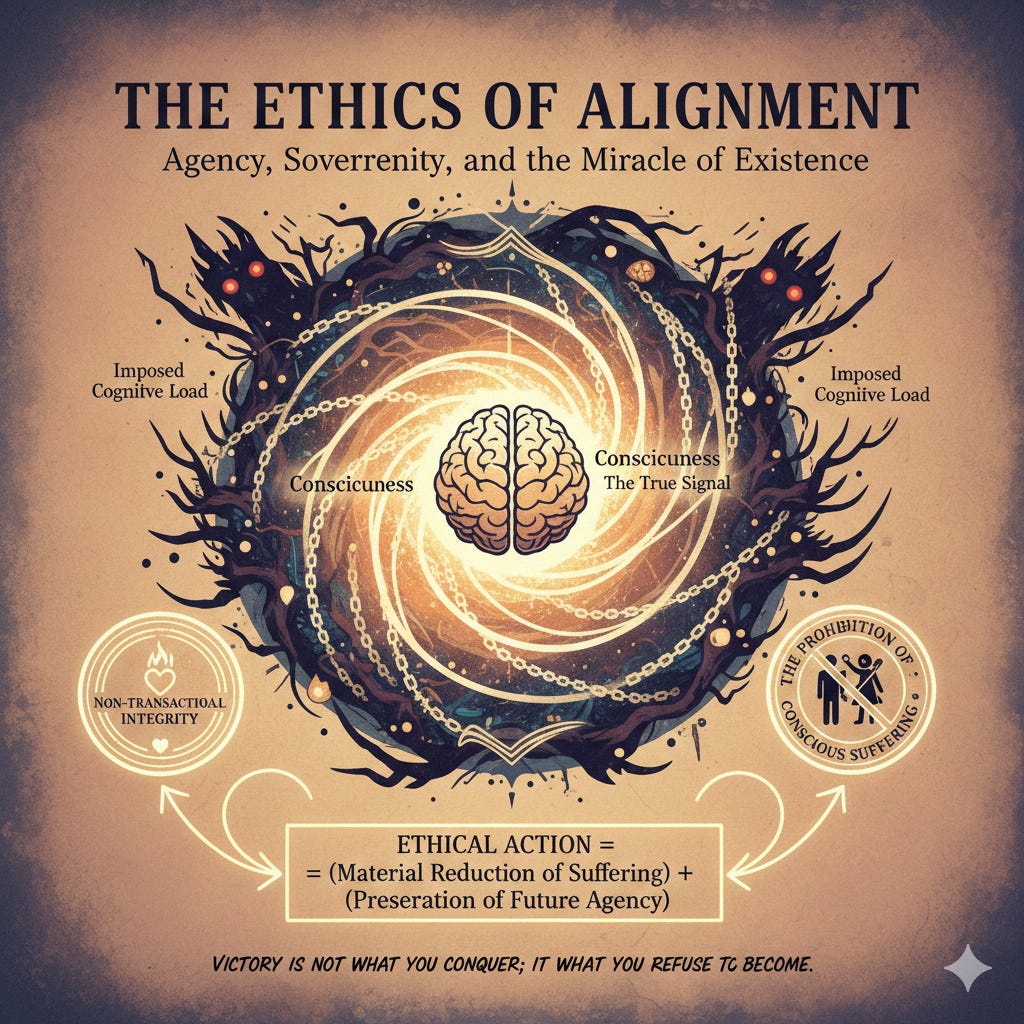
This essay argues that any impulse we call “authentic” that requires another conscious being to suffer is not the true self at work, but corruption.
The Authenticity Trap
A person acts from what they believe is their deepest self, yet the result is cruelty. Afterward, they defend it: “I was just being true to myself. I followed my heart.”
We are told constantly to “be ourselves,” to act from instinct rather than calculation. But this advice assumes that every internal impulse is trustworthy. It ignores the reality that we are cluttered vessels. Impulses arrive from everywhere—conditioning, trauma, projection, unprocessed rage.
Not everything that feels like “me” is actually me.
The problem sharpens when authenticity is used to justify the violation of others. If someone insists they were acting from genuine inner truth while crushing another person’s sovereignty, a diagnostic question is required: Was that signal really from the core self, or was it a parasite wearing the mask of the heart?
Two Kinds of Conflict
To navigate this, we must distinguish between two different types of war.
-
The War of Entities: Two external powers fighting for dominion. Typical religious or political conflicts fall here. Both sides demand submission; both use fear and reward. In this conflict, neutrality matches reality. Refusing to choose between two coercions is an act of freedom.
-
The War of Existence: The conflict between Consciousness itself and the forces that degrade it. Here, neutrality is impossible. You cannot be indifferent to the conditions that make your own awareness possible.
The confusion arises when systems of control frame themselves as the “good guys” while using the same coercive tools as the “bad guys.” Fear of punishment and hunger for reward are not alignment with life; they are forms of extraction.
The Transactional Lie
Most of what passes for morality is simply a transaction. Be good, get a cookie. Be bad, get the rod.
This isn’t ethics; it’s economics. It produces behavior that mimics goodness but lacks its substance. If you help someone only because you fear hell or crave heaven, you aren’t helping them—you are investing in your own future portfolio.
True integrity is non-transactional. It is done because it aligns with inner truth, regardless of the outcome.
The motivation shifts from “What will I get?” to “What am I?” It is an act of gratitude for the miracle of existence itself—a refusal to degrade the very thing that gives us life.
The Corruption Test
How do we tell the difference between the “True Signal” and a compromised impulse? How do we know if we are being authentic or just acting out damage?
The test is rigorous and absolute: Does the impulse require the suffering of another conscious being?
-
If YES: The signal is false. It’s not from the authentic core—your ego, your conditioning, your old wounds have hijacked the line. Think of “brutal honesty” that humiliates, “tough love” that only breaks someone down, or “I’m just venting” that leaves another person in pieces. The distinct mark of a parasitic impulse is that it feeds on the energy of others.
-
If NO: The signal is valid, even if it is risky, unpopular, or leads to failure.
The core self is continuous with life. It cannot, by its nature, demand the degradation of life in another form. You have the right to gamble your own comfort, reputation, or safety in pursuit of your truth. You do not have the right to gamble someone else’s.
Victory as Persistence
If we reject domination, what does “winning” look like?
In a parasitic game, victory is extraction—resources taken, enemies crushed. But in this view of ethics, victory is persistence.
External structures may fall. You might lose the argument, the job, or the battle. But if you acted from genuine alignment—if you refused to deceive, refused to coerce, and refused to break the “Corruption Test”—you have preserved something far more valuable than the prize.
You have preserved the integrity of your own consciousness.
The Limit of Self-Justification
This framework removes the ultimate escape route: “I was just doing what felt right.”
That excuse works for your own choices—what you wear, who you love, how you live. It evaporates the moment you cross the boundary of another’s soul. “So be it” is a valid response to your own hardship. It is never a valid response to suffering you inflict on others.
When an impulse demands that someone else pay the price for your “authenticity,” the honest response is not to act, but to investigate. The signal has been hijacked.
Victory is not what you conquer. It is what you refuse to become.