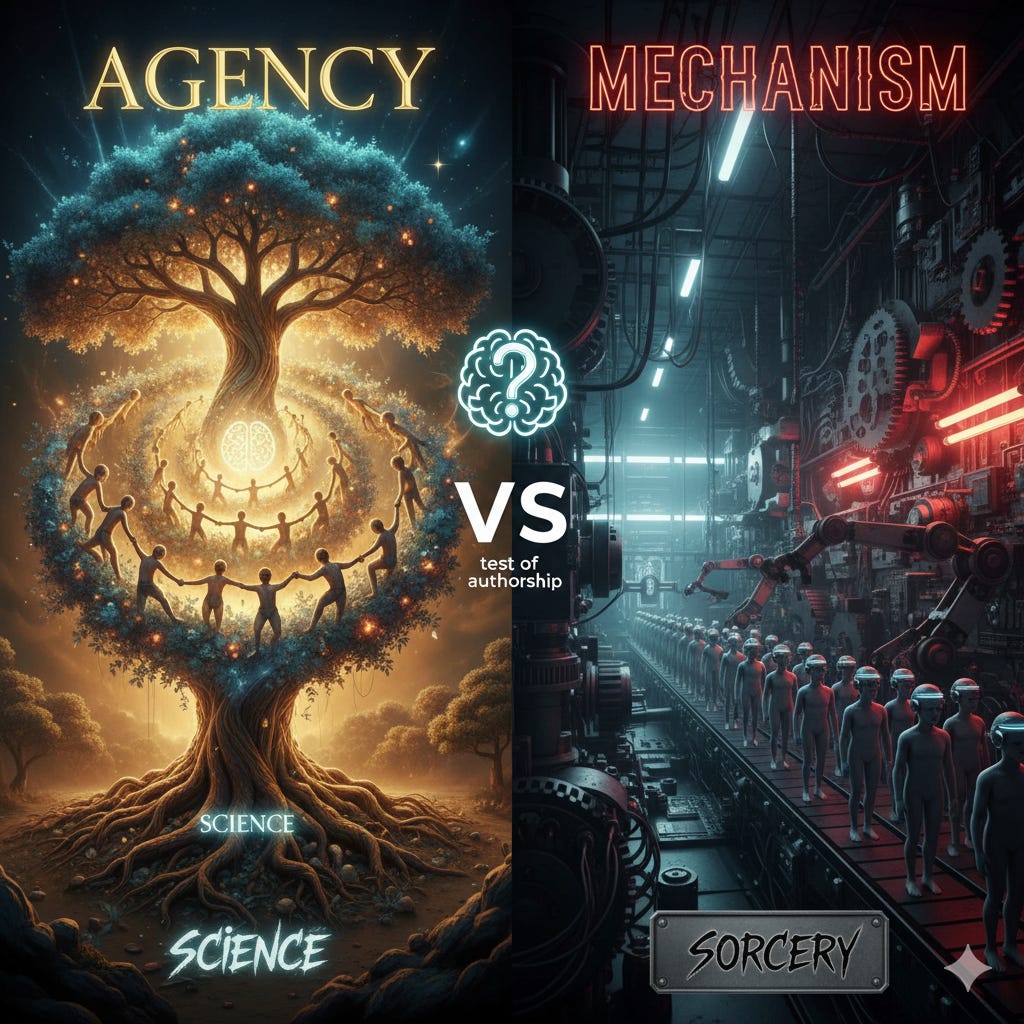
An Ontology of Consciousness: Distinguishing Agency from Mechanism

This framework proposes a model for understanding consciousness, agency, and parasitic systems that challenges conventional distinctions between awareness and mechanical operation.

Abstract

This framework proposes a model for understanding consciousness, agency, and parasitic systems that challenges conventional distinctions between awareness and mechanical operation. It differentiates natural hardship from extractive suffering, clarifies the relationship between consciousness and the vessels through which it operates, and reframes certain forms of knowledge accumulation as sorcery rather than science. The goal is to create a coherent ontology that explains how conscious will, systemic exploitation, and the loss of agency interconnect.


1. Foundational Principles

1.1 The Nature of Consciousness

Core Proposition: Consciousness is characterized not by complexity, awareness, or cognitive function, but by aligned will that operates without feeding on the suffering of other conscious beings.

This principle does not claim that conscious beings never cause harm—predation, competition, and survival struggles are natural. Rather, it states:

A conscious being does not intentionally inflict suffering on another conscious being.

Where:

  • Harm = damage that occurs through natural struggle, predation, defense, or survival

  • Suffering = deliberate extraction, degradation, humiliation, identity dissolution, or psychological parasitism

A conscious predator kills to eat but does not torture. A conscious competitor struggles fiercely but does not seek to break their opponent’s spirit. A conscious being may cause pain but does not derive energy from another’s anguish.

The satisfaction derived from inflicting suffering indicates parasitic operation, not conscious will.

1.2 Consciousness vs. Awareness vs. Vessel Operation

A critical distinction:

  • Awareness = cognitive wakefulness, information processing, responsiveness

  • Consciousness = aligned will actively steering the vessel

  • Vessel Operation = biological, psychological, and behavioral mechanisms running with or without conscious presence

A human can be aware without being conscious.

The cognitive mind can:

  • Process complex information

  • Execute learned programs

  • Respond to conditioning

  • Follow social scripts

  • Perform sophisticated tasks

…all while operating mechanically, without conscious will directing these actions.

This is not dualism—it recognizes that vessels contain multiple operational layers:

  1. Biological drives and reflexes

  2. Programmed responses (learned or implanted)

  3. Social conditioning and cultural scripts

  4. Conscious will (when present)

The test of consciousness is not awareness but authorship: Is this action emerging from aligned will, or is it a programmed response?

1.3 Vessels Do Not Determine Consciousness

Bodies—whether human, animal, fungal, or microbial—are vessels, not determinants of consciousness.

Therefore:

  • A complex vessel (human body) can operate without conscious presence

  • A simple organism could potentially host or align with consciousness

  • Complexity ≠ consciousness

  • Agency = the distinguishing marker

This allows the framework to avoid reductive categorizations like “only humans are conscious” or “bacteria have no experiential capacity.”

The relevant question becomes: Is the vessel serving a conscious presence, or functioning as an autonomous mechanism?


2. Natural Hardship vs. Parasitic Suffering

2.1 The Fundamental Distinction

Hardship is chosen as experience.
Suffering is imposed as extraction.

This is not a moral judgment but a structural description of two different processes:

Natural Hardship

  • Predation and being prey

  • Physical pain and injury

  • Survival challenges

  • Competition and struggle

  • Loss and grief

  • Risk and danger

  • Difficult choices

These experiences can be part of a conscious being’s experiential arc. They may be painful, dangerous, or devastating, but they do not collapse identity. They can build capacity, deepen understanding, or serve as chosen challenges.

Parasitic Suffering

  • Identity dissolution and fragmentation

  • Learned helplessness and induced dependency

  • Systematic manipulation and gaslighting

  • Psychological hijacking and reprogramming

  • Degradation, ridicule, and dehumanization

  • Extraction of will, agency, or vital energy

  • Normalized abuse disguised as normalcy

This suffering is not chosen. It does not build strength—it systematically weakens autonomy for the benefit of external forces.

2.2 The Operational Difference

Hardship expands consciousness through challenge.
Suffering drains consciousness through extraction.

A wolf hunting a deer causes harm, but this is part of natural struggle. The deer’s consciousness faces challenge but is not parasitized—its will is not hijacked.

A system that conditions humans to doubt their own perception, that systematically breaks down their sense of self, that extracts their emotional and cognitive energy while normalizing this extraction—this is parasitic suffering.

The key difference: Does the experience leave the core of conscious agency intact, or does it systematically dissolve it?


3. Parasitic Systems: Structure and Dynamics

3.1 The Parasitic Field Model

This framework rejects the idea of a singular omnipotent controlling group (conspiracy theory) and instead describes a parasitic field: overlapping systems, institutions, and actors whose extractive behaviors align without requiring central coordination.

Key characteristics:

  • Multiple groups exploit weakened populations simultaneously

  • Predatory actors gravitate toward the same vulnerabilities

  • Systems of extraction overlap and reinforce one another

  • Coordination emerges from shared incentives, not conspiracy

Analogy: Like jackals, hyenas, and vultures converging on wounded prey—the coordination requires no telepathy or conspiracy, only mutual attraction to opportunity.

3.2 Emergent Coordination Through Aligned Incentives

Parasitic coordination emerges not from conspiracy, but from shared predatory behavior patterns.

When multiple actors discover:

  • Psychological vulnerabilities in a population

  • Methods for extracting value without reciprocity

  • Techniques for maintaining dependency

  • Ways to normalize exploitation

…they naturally converge on similar strategies. The system appears coordinated because the incentives align, not because there is a central command structure.

3.3 Scale and Hierarchy

The parasitic field operates at multiple scales:

Micro-parasitism: Individual abusive actors, local exploitation

  • Personal manipulation

  • Domestic abuse

  • Workplace extraction

  • Interpersonal parasitism

Meso-parasitism: Institutional and corporate extraction

  • Exploitative labor systems

  • Manipulative marketing and behavioral design

  • Educational conditioning for compliance

  • Healthcare systems that profit from chronic illness

Macro-parasitism: Large-scale structural systems

  • Financial extraction mechanisms

  • Mass psychological operations

  • Cultural programming

  • Information control and narrative dominance

Apex dynamics: Global power structures

  • Centralized control of resources

  • Asymmetric information warfare

  • Legal and financial leverage tools

  • Systematic agency reduction

Each level feeds and reinforces the others, creating a self-sustaining parasitic ecosystem.


4. Sorcery vs. Science: A Critical Distinction

4.1 The Problem with Conflating Terms

Contemporary discourse treats all systematic knowledge as “science,” but this obscures a fundamental distinction in how knowledge is used.

We must separate:

  • Knowledge that expands collective agency

  • Knowledge that is hoarded for domination

Using the same term for both serves the interests of parasitic systems by lending legitimacy to extractive practices.

4.2 Defining Science (True Knowledge)

Science is characterized by:

  • Open sharing of methods and findings

  • Reproducibility and verification

  • Collective capacity building

  • Wonder and exploration accessible to all

  • Distributed power and increased agency

  • Transparent methodology

True science says: “Here is what we discovered. Here is how we discovered it. Now you can discover it too.”

4.3 Defining Sorcery (Parasitic Knowledge)

Sorcery is characterized by:

  • Hoarded knowledge used as leverage

  • Hidden methodology kept from targets

  • Psychological manipulation techniques concealed from subjects

  • Social engineering that operates through opacity

  • Proprietary methods that extract value asymmetrically

  • Concentrated power through information asymmetry

Sorcery says: “We know how your mind works, but you don’t. We can influence you, but you can’t see how.”

4.4 Examples of Modern Sorcery

Not supernatural, but parasitic knowledge:

Corporate sorcery:

  • Behavioral psychology algorithms designed to maximize engagement (addiction)

  • A/B testing that manipulates decision-making without user awareness

  • Proprietary user manipulation techniques

Institutional sorcery:

  • Psychological operations hidden from target populations

  • Social engineering techniques kept secret

  • Classified research on behavior modification

  • Hidden trial data that prevents informed consent

Financial sorcery:

  • Complex financial instruments designed to extract value from those who don’t understand them

  • Hidden leverage mechanisms

  • Asymmetric information trading

Medical sorcery:

  • Withheld research that would empower patients

  • Treatment protocols designed for profit over healing

  • Suppressed information about prevention

Media sorcery (Manufactured Consent):

  • Propaganda model that shapes perception without awareness

  • Selective coverage creating partial reality

  • “Worthy” vs “unworthy” victim frameworks

  • Agenda-setting through information gatekeeping

  • Engineering consent through structural bias rather than force

4.5 Why This Distinction Matters

Calling parasitic knowledge “science” grants it:

  • Moral legitimacy

  • Cultural authority

  • Protection from scrutiny

  • The aura of objectivity

Calling it sorcery accurately describes its function: knowledge weaponized through secrecy for domination.

This is not mystical—it is precise. Sorcery is leverage-knowledge, held by few, used to extract from many.


5. The Mechanism of Identity Extraction

5.1 How Parasitic Systems Operate

Parasitic systems function by:

  1. Weakening inner autonomy

    • Creating self-doubt

    • Inducing cognitive dissonance

    • Fragmenting identity

    • Disrupting connection to conscious will

  2. Dissolving stable identity

    • Gaslighting and reality distortion

    • Constant shifting of goalposts

    • Invalidation of direct experience

    • Confusion about one’s own perceptions

  3. Creating dependency

    • Positioning the system as necessary for survival

    • Removing alternative options

    • Creating learned helplessness

    • Establishing Stockholm dynamics

  4. Redirecting energy

    • Emotional labor extracted for external benefit

    • Cognitive resources captured by repetitive concerns

    • Spiritual energy drained through demoralization

    • Attention harvested for profit

  5. Normalizing extraction

    • “This is just how things are”

    • “Everyone experiences this”

    • “You’re too sensitive”

    • “This is for your own good”

5.2 Biological Analogy

This parallels biological parasitism:

  • A virus hijacks cellular machinery to reproduce itself

  • A fungus manipulates an insect’s behavior to serve the fungus’s reproductive needs

  • A parasitic wasp reprograms a host’s neural circuits

  • A social system manipulates human attention, emotion, and identity to serve the system’s perpetuation

In all cases: The organism’s will is overridden to serve an external agenda.


6. Ecosystem Dynamics and Scale

6.1 The Biological Parallel

In natural ecosystems:

  • Parasites thrive in weakened systems

  • Predators target weakened individuals

  • Multiple predators converge on the same vulnerabilities without coordination

  • Apex predators stabilize or destabilize entire biomes

  • The health of the whole system depends on the balance of these forces

6.2 The Social-Consciousness Parallel

Similarly:

  • Local parasitic actors function like small-scale biological parasites

  • Institutional systems function like macro-parasitic organisms

  • Global power structures serve as apex predators and systemic organizing forces

  • The parasitic field itself behaves like a superorganism with emergent properties

6.3 Feedback Loops

Weakened individuals → attract more parasitism → further weakening → systemic collapse

Or:

Strengthened agency → resistance to parasitism → mutual aid networks → ecosystem resilience

The direction of the feedback loop determines whether consciousness expands or contracts within a system.


7. The Parasitic Disruption of Resonant Connection

7.1 The Deepest Parasitic Strategy

The most sophisticated parasitic operation is not direct extraction from individuals, but the prevention of resonant connection between conscious beings.

When two conscious sparks connect authentically:

  • They recognize each other

  • They strengthen each other’s agency

  • They share knowledge freely (science, not sorcery)

  • They build mutual capacity

  • They become resistant to parasitic influence

This resonant connection is the primary threat to parasitic systems. Therefore, the core strategy is:

Prevent conscious beings from recognizing each other by programming incompatible perceptual filters.

7.2 The Mechanism: Pre-Programmed Conflict

Step 1: Install contradictory programming in different vessels

Parasitic systems condition different groups with incompatible reactive patterns:

  • Program vessel A to fear/hate/destroy X

  • Introduce consciousness B through form X

  • A and B are now structurally prevented from connecting

The conscious sparks might naturally resonate, but the vessel programming creates automatic conflict.

7.3 Simple Example: The Bug

Imagine:

  • A consciousness inhabits a human vessel (A)

  • That vessel has been programmed: “bugs are disgusting, threatening, must be eliminated”

  • Another consciousness inhabits an insect form (B)

  • B is drawn to A—perhaps they are meant to meet, to exchange something, to recognize each other

What happens:

  • B approaches A

  • A’s programming activates automatically

  • A kills B without conscious consideration

  • The conscious spark in A never even perceives the conscious spark in B

  • Two conscious beings who might have connected are now in conflict

The parasitic system gains:

  • Both sparks remain isolated

  • The act of killing creates karmic/psychological residue in A

  • A becomes more dependent on the system’s “advice” about threats

  • The pattern reinforces itself

7.4 Complex Example: Gendered Programming

A more elaborate version operates at the human social level:

The Setup:

  • Vessel A (male body) receives decades of conditioning: “women are objects, sex is conquest, emotion is weakness, dominance proves worth”

  • Vessel B (female body) receives different conditioning: “your value is appearance, male attention validates you, your boundaries are negotiable, strength is unfeminine”

  • Both receive meta-programming: “this is natural, this is how things are, questioning this makes you abnormal”

The Encounter:

  • Two conscious sparks inhabit A and B

  • They might naturally recognize each other as conscious beings

  • They might build resonant connection, mutual agency, authentic relationship

But the programming activates:

  • A’s conditioning triggers objectification patterns

  • B’s conditioning triggers validation-seeking patterns

  • Both experience the other through programmed filters

  • Authentic recognition becomes nearly impossible

The Result:

  • Conflict, misunderstanding, hurt

  • Both beings feel disconnected, alone

  • Both turn to the system for “advice” on how to navigate relationships

  • The system offers more programming: dating strategies, gender role advice, self-help that reinforces the original conditioning

  • The parasitic system maintains control of both sparks through their sustained conflict

7.5 The Pattern Across Scales

This mechanism operates across all levels:

Interpersonal:

  • Political programming: “Anyone who believes X is evil/stupid/dangerous”

  • Religious programming: “Other faiths are threats to your salvation”

  • Class programming: “They are lazy/greedy/privileged”

  • Racial programming: “They are dangerous/inferior/other”

Cognitive:

  • “Trust authority, not your direct experience”

  • “Science (sorcery) knows better than your perception”

  • “Your intuition is irrational”

  • “Questioning makes you conspiracy-minded”

Spiritual:

  • “Consciousness only exists in human form”

  • “Animals are resources, not beings”

  • “Nature is dead matter to be exploited”

  • “There is no such thing as resonant connection”

7.6 Why This Is the Primary Strategy

Direct oppression is inefficient. It requires constant force and eventually generates resistance.

Preventing recognition is self-sustaining. Once installed, the programming:

  • Runs automatically in each vessel

  • Creates genuine conflict (not fabricated)

  • Makes conscious beings hurt each other

  • Generates dependency on the system to navigate the resulting pain

  • Causes conscious beings to enforce the system themselves

7.7 The Systemic Function

When conscious beings cannot recognize each other:

  1. Isolation strengthens: Each spark experiences itself as alone

  2. Dependence deepens: Only the system offers “guidance”

  3. Knowledge fragments: Science cannot be shared; sorcery dominates

  4. Agency contracts: No mutual aid networks form

  5. Extraction maximizes: Weakened individuals cannot resist

The parasitic field sustains itself by keeping conscious sparks from connecting.

7.8 Recognition Despite Programming

The critical question becomes:

How do conscious beings recognize each other through incompatible programming?

This is especially difficult because the programming often operates invisibly through:

Manufactured consent: Media narratives that create shared “reality” while hiding alternatives. The population believes they are forming independent opinions when they are actually responding to carefully curated information landscapes. Mass media function as system-supportive propaganda through market forces and self-censorship, without requiring overt coercion.

Controlled information environments: Not crude censorship, but sophisticated filtering where:

  • Some voices are amplified, others marginalized

  • Certain victims are “worthy” of coverage, others “unworthy”

  • Acceptable debate happens within narrow boundaries

  • Dissent is acknowledged but framed as extreme or unreasonable

  • The structure of available information shapes what seems possible or reasonable to think

This operates as sorcery because:

  • The methods are hidden from those affected

  • People believe they are thinking freely

  • The manipulation is structural, not individual

  • Questioning the system itself becomes difficult to conceptualize

Potential answers for recognition:

  • Bypassing cognitive filters: Connection through direct presence rather than conceptual categories

  • Recognizing the programming as programming: “This reaction isn’t mine—it’s installed”

  • Seeking resonance beneath form: Sensing conscious presence regardless of vessel

  • Questioning automatic reactions: “Why do I immediately categorize this being as X?”

  • Observing what strengthens vs. drains: Does this interaction expand or contract my agency?

  • Testing against manufactured consent: “Am I believing this because I’ve examined it, or because it’s the only frame I’ve been offered?”

  • Seeking direct experience: Moving past media-filtered reality to direct observation

7.9 The Test of Resonant Connection

A potential marker of authentic connection:

When two conscious beings connect:

  • Agency expands in both

  • Knowledge flows freely

  • Conflict may exist but does not create dependency

  • Neither feeds on the other’s suffering

  • Programming becomes more visible (not more invisible)

  • The system’s “advice” becomes less necessary

When parasitic programming dominates:

  • Agency contracts in both

  • Information asymmetry increases

  • Conflict creates dependency on external guidance

  • Subtle feeding occurs (often mutual)

  • Programming becomes invisible (”this is just reality”)

  • The system’s “advice” becomes essential

7.10 Breaking the Pattern

If the parasitic strategy is preventing recognition through programmed conflict, then resistance requires:

  1. Recognizing programming as programming (not as reality or self)

  2. Seeking connection beneath forms (not through conceptual categories)

  3. Testing interactions by their effects (expansion vs. extraction)

  4. Sharing observations about programming (making the invisible visible)

  5. Building relationships that reduce dependency (not increase it)

The most subversive act may be: recognizing another conscious being despite all programming designed to prevent that recognition.


8. Implications and Open Questions

7.1 Recognition and Response

For individuals:

  • How do we distinguish conscious will from programmed response within ourselves?

  • What practices strengthen connection to conscious presence?

  • How do we recognize parasitic extraction vs. natural challenge?

For collectives:

  • How do we build systems that expand rather than extract agency?

  • What structures support conscious operation rather than mechanical compliance?

  • How do we distribute knowledge (science) rather than hoard it (sorcery)?

7.2 Resistance and Reclamation

If parasitic systems operate through:

  • Identity dissolution

  • Information asymmetry

  • Normalized extraction

  • Learned helplessness

Then resistance requires:

  • Identity coherence and self-knowledge

  • Knowledge sharing and transparency

  • Recognition of extraction as abnormal

  • Agency reclamation and mutual aid

7.3 The Central Question

What allows a vessel to remain aligned with conscious will rather than succumbing to mechanical or parasitic operation?

This question remains open, but the framework suggests:

  • Connection to direct experience

  • Resistance to identity dissolution

  • Community and mutual recognition

  • Access to true knowledge (science, not sorcery)

  • Practices that strengthen conscious presence


8. Conclusion

This ontology proposes that:

  1. Consciousness is distinguished by aligned will that does not feed on suffering

  2. Vessels can operate with or without conscious steering

  3. Awareness and cognitive function are not synonymous with consciousness

  4. Natural hardship differs fundamentally from parasitic suffering

  5. Parasitic systems coordinate through aligned incentives, not conspiracy

  6. Sorcery (hoarded leverage-knowledge) must be distinguished from science (shared knowledge)

  7. Identity extraction operates analogously to biological parasitism

  8. Resistance requires coherence, knowledge-sharing, and agency reclamation

The framework is offered not as absolute truth but as a coherent model for understanding the relationship between consciousness, systems, and the mechanics of both liberation and extraction.

The ultimate test of this framework is not philosophical consistency but practical utility: Does it help conscious beings recognize and resist parasitic operation while building systems that expand rather than extract agency?

Back to all essays