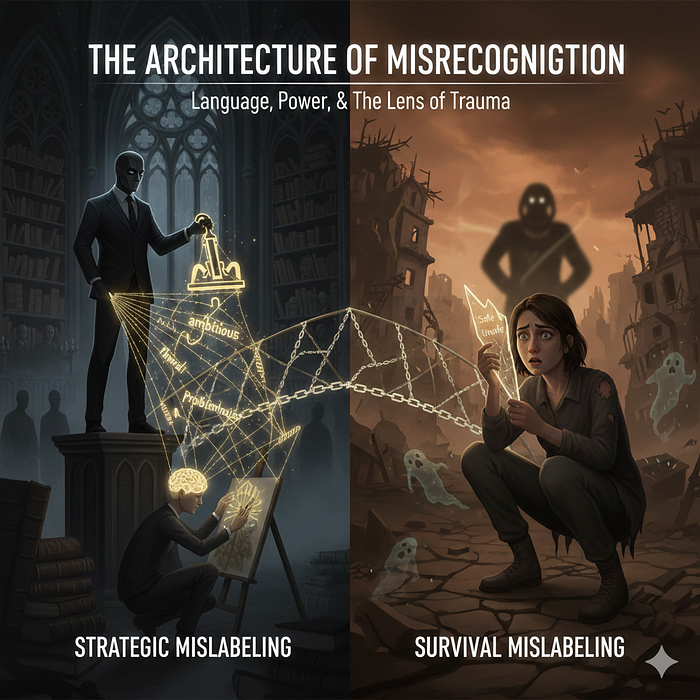
The Architecture of Misrecognition: A Framework for Conscious Discernment

This essay presents a systematic framework for understanding the distinction between conscious and mechanical human operation, building upon clear principles rather than subjective interpretation.

Introduction: Two Kinds of Mislabeling, One Mechanism

When we encounter harm — whether in a work of art that disturbs us, or in a person whose actions wound others — we face a choice about how to see. Do we respond with a label that closes inquiry, or with a question that opens understanding?

This article addresses a paradox: the same linguistic mechanism (vague labeling) serves completely opposite functions in different contexts.

Type 1: Strategic Mislabeling for Dominance

  • Used by those in positions of power or safety
  • Functions to rationalize control, dismiss threats to hierarchy, justify harm
  • Example: A critic calling innovative work “ambitious but flawed” to enforce their gatekeeping authority
  • Example: Brutus labeling Caesar “ambitious” to rationalize assassination
  • The mislabeling is a weapon of the secure against the threatening

Type 2: Survival Mislabeling for Protection

  • Used by those in immediate danger or resource scarcity
  • Functions as rapid threat assessment when deeper analysis is a luxury
  • Example: A traumatized community labeling an aggressive member “evil” because they lack resources to address root causes
  • Example: A person who must quickly categorize others as “safe/unsafe” to survive
  • The mislabeling is a shield of the vulnerable against perceived threat

Both use the same tool (vague labels that collapse complexity), but the ethical weight is completely different:

  • Type 1 is manipulation from a position of advantage
  • Type 2 is survival response under constraint

The tragedy is that Type 1 often creates the conditions that make Type 2 necessary. The powerful misuse language to dominate, which generates trauma, which forces the traumatized to use crude labels for self-protection, which the powerful then cite as evidence of the traumatized being “naturally” flawed.

This article maps both dynamics — not to equate them, but to show how the same linguistic error perpetuates harm in opposite directions.

Press enter or click to view image in full size

Part I: The Mechanics of Mislabeling

The Function of Vague Language

Consider these common phrases:

  • “That work is ambitious but flawed”
  • “He’s just a bad person”
  • “She’s always been difficult”

Each statement appears to describe reality. But look closer at what they actually accomplish:

  1. They close inquiry (no further questions needed)
  2. They locate the problem in the person/work (not in context, history, or relationship)
  3. They preserve the speaker’s authority (I can diagnose; you cannot object without seeming defensive)

But here’s the critical distinction we must maintain throughout:

When used from positions of power/safety: This linguistic move is often strategic manipulation — a tool for maintaining dominance while appearing objective.

When used from positions of vulnerability/scarcity: This same linguistic move becomes a survival heuristic — a rapid sorting mechanism when deeper analysis could be fatal.

The mechanism is identical. The ethical status is opposite.

Type 1: Strategic Mislabeling (Manipulation from Power)

This is vague language deployed by those who have the luxury of nuance but choose to withhold it for strategic advantage.

Shakespeare’s Diagnostic: The “Ambitious” Murder

In Julius Caesar, Brutus doesn’t kill Caesar for a crime. He kills him for a quality: ambition. Watch how the language works:

  • Caesar’s potential for tyranny becomes treated as actual tyranny
  • An abstract trait (“ambitious”) substitutes for concrete evidence
  • The murder is reframed as prevention, not violence

Shakespeare shows us something crucial: vague language enables those in power to harm while believing they’re being rational.

Brutus had time, resources, and safety to analyze Caesar accurately. He chose not to. The vagueness was strategic — it allowed the conspirators to:

  • Maintain plausible deniability (“We’re not murderers; we’re patriots”)
  • Avoid confronting Caesar’s actual governance (which was often beneficial to the poor)
  • Rally others through abstract fear rather than concrete evidence

Contemporary Examples of Type 1:

  • The tenured critic dismissing innovative work as “ambitious but flawed” (translation: “You’ve threatened the hierarchy I police”)
  • The HR department labeling a whistleblower “difficult” (translation: “You’ve endangered our power structure”)
  • The colonial administrator calling indigenous resistance “savage” (translation: “Your refusal to submit must be pathologized”)

Identifying Type 1: Ask these questions:

  • Does the labeler have resources to investigate deeper?
  • Does precision threaten their position?
  • Does the vagueness enable harm while maintaining innocence?

If yes → This is strategic mislabeling. It should be named and resisted.

Type 2: Survival Mislabeling (Protection from Vulnerability)

This is the same linguistic mechanism, but deployed from a completely different position: when you lack the resources for nuanced analysis because survival is immediate.

The Traumatized Community

Consider a neighborhood experiencing concentrated poverty, violence, and abandonment. Someone in that community becomes aggressive, stealing, threatening others. The community labels them “evil” or “just bad.”

From outside, we might judge this labeling as unsophisticated. But look at the context:

  • No one has access to mental health resources
  • No one has time/safety to trace the person’s trauma history
  • The immediate question is: “Will this person hurt my child today?”
  • Deeper analysis is materially impossible given constraints

The label isn’t manipulation — it’s rapid threat assessment under duress.

The Crucial Distinction:

Type 1 (Brutus): Had power, resources, and safety. Chose vagueness strategically.

Type 2 (Traumatized community): Lacks power, resources, and safety. Requires rapid categorization to survive.

Both use vague labels. But demanding the traumatized community “do better” without addressing their constraints is itself a form of violence.

Contemporary Examples of Type 2:

  • An abuse survivor who labels all authority figures “dangerous” (necessary heuristic given their history)
  • A marginalized community that trusts no outsiders (learned from repeated betrayal)
  • A person who sees all intimacy as threat (survival code installed by early violation)

Identifying Type 2: Ask these questions:

  • Does the labeler lack resources for deeper inquiry?
  • Would precision require vulnerability they cannot afford?
  • Is the crude categorization the best available tool given constraints?

If yes → This is survival mislabeling. It should be understood as adaptation, not moral failure.

The Vicious Cycle

Here’s where it gets tragic: Type 1 creates the conditions that necessitate Type 2, which Type 1 then uses to justify continued dominance.

  1. Power structures use strategic mislabeling to oppress (Type 1)
  2. This creates trauma, scarcity, and danger for the oppressed
  3. The oppressed develop crude categorization systems to survive (Type 2)
  4. The powerful point to these crude systems as evidence of “natural” inferiority
  5. This justifies continued strategic mislabeling (back to Type 1)

Breaking this cycle requires distinguishing the two types. We cannot fight Type 1 and Type 2 with the same response:

  • Type 1 requires exposure and resistance (calling out strategic vagueness)
  • Type 2 requires resource provision and compassion (creating conditions where nuance becomes possible)

Part II: Distinguishing the Person from the Pattern

The Central Insight

When someone exhibits harmful behavior, we typically ask: “What kind of person does this?”

A more useful question: “What kind of experience produces this behavior?”

This isn’t about removing responsibility. It’s about locating causation accurately.

The Mechanics of Trauma Response

Research across neuroscience, developmental psychology, and trauma studies converges on this: extreme or chronic threat fundamentally alters how a person processes reality.

The sequence typically looks like this:

  1. Original Experience: A child experiences violence, neglect, or betrayal by caregivers
  2. Survival Adaptation: The nervous system generates protective strategies (hypervigilance, emotional shutdown, preemptive aggression)
  3. Pattern Installation: These strategies become automatic, operating below conscious awareness
  4. Social Response: Others react to the behavior (hostility, withdrawal, manipulation) without seeing the mechanism
  5. Confirmation: The person’s worldview is reinforced (“People will hurt me; I must protect myself first”)

What society labels as “evil” or “bad character” is often a survival system operating in the absence of the original threat.

A Critical Distinction

This framework does NOT claim:

  • That all harmful behavior originates in trauma
  • That understanding causation eliminates consequences
  • That accountability is inappropriate

It claims only this: We cannot address a problem we misdiagnose.

If someone’s aggression is a trauma response, punishment without intervention simply confirms their expectation that power equals pain. We become part of the cycle we claim to oppose.

Part III: The Three Levels of Conscious Response

To interrupt the reproduction of harm, we need discernment at three distinct levels:

Level 1: Immediate Containment (Pragmatic)

Question: What must stop right now?

When someone is actively causing harm, the first response is practical: create safety. This isn’t punishment; it’s boundary-setting. A person drowning will pull others under — this doesn’t make them evil, but you still need to establish distance.

Principle: Contain the behavior without condemning the being.

Level 2: Accurate Diagnosis (Analytical)

Question: What is actually happening here?

This requires separating what we see from what we conclude:

  • Observable: This person responds to perceived threats with immediate aggression
  • Premature conclusion: “They’re just violent by nature”
  • Deeper inquiry: “What taught them that preemptive attack equals survival?”

The goal isn’t to excuse, but to identify the actual mechanism so we can address it effectively.

Principle: Describe the pattern without collapsing it into an identity.

Level 3: Addressing the Source (Systemic)

Question: What created this pattern, and how do we prevent its reproduction?

If we only address individual symptoms while leaving the generating conditions intact, we guarantee the pattern’s continuation. This level asks:

  • What institutions normalize the original harm?
  • What social conditions make defensive aggression necessary?
  • How does our response (punishment, stigma, isolation) reinforce the very patterns we oppose?

Principle: Interrupt the machinery, not just its output.

Part IV: Practical Application

In Art Criticism

Instead of: “This film is ambitious but flawed — the director clearly overreached”

Try: “This film attempts X and achieves Y. The gap between intention and execution reveals Z about the constraints the creators worked within.”

The first approach enforces hierarchy. The second opens inquiry.

In Interpersonal Conflict

Instead of: “You’re just controlling/selfish/impossible”

Try: “When X happens, you respond with Y. I experience this as Z. Can we look at what’s actually happening?”

The first approach closes the person. The second invites them into shared investigation.

In Social Justice

Instead of: “These people are criminals/deviants/irredeemable”

Try: “These behaviors emerge under specific conditions. What are those conditions, and how do we transform them?”

The first approach perpetuates the cycle. The second seeks leverage points for actual change.

Part V: The Reality of Context — When Clarity Feels Like Luxury

The Privilege Paradox and the Two-Track Problem

Here’s where the framework must become more honest: applying this kind of analysis is itself a privilege.

But there are actually TWO completely different scenarios where “luxury consciousness” becomes relevant:

Scenario A: The Critic with Power (Type 1 labeler)

  • Has resources, safety, time
  • Chooses not to look deeper because precision would threaten their advantage
  • Their “I don’t have time for nuance” is false scarcity — a rationalization for strategic vagueness

Scenario B: The Traumatized Person/Community (Type 2 labeler)

  • Lacks resources, safety, time
  • Cannot look deeper because survival is immediate
  • Their “I don’t have time for nuance” is real scarcity — a material constraint

The framework’s demand shifts based on which scenario we’re in:

For Type 1: You have the resources. Your refusal to look deeper is ethical failure. The framework asks you to stop weaponizing vagueness.

For Type 2: You lack the resources. Your inability to look deeper is adaptation under duress. The framework doesn’t ask anything of you directly — instead it asks those with resources to create conditions where deeper seeing becomes possible for you.

The Escalation Effect (Type 2 Context)

Yet here’s what we observe: communities trapped in collective trauma often perpetuate the exact patterns that wounded them. The abused becomes the abuser. The oppressed community develops internal hierarchies of cruelty. The survival mechanism that once protected now destroys from within.

Why? Because without any framework for seeing the machinery, people can only respond to symptoms. They fight each other instead of recognizing they’re all running the same defensive code.

Incremental Consciousness — Every Drop Matters

The framework doesn’t need to be applied perfectly to have effect. Even partial awareness shifts outcomes:

Stage 0: “That person is evil” → punishment, no change in conditions Stage 1: “That person learned to survive this way” → punishment continues, but slight reduction in demonization Stage 2: “We’re both responding to the same machinery” → recognition of shared causation Stage 3: “What would interrupt this cycle?” → search for leverage points begins

Moving from Stage 0 to Stage 1 is not complete transformation. But it’s enough of a gap for something new to enter.

The Practical Minimum

You don’t need to apply this framework to everyone. You might only have capacity for one moment of inquiry:

  • The parent who pauses one second before yelling at their child
  • The neighbor who asks “What happened to you?” instead of “What’s wrong with you?”
  • The community member who says “We learned this from somewhere” instead of “We’re just like this”

Each moment of recognition is a microchip of consciousness entering the system. It doesn’t need to solve everything. It just needs to be slightly different than pure reaction.

When Survival Takes Priority

There are moments when this framework must be set aside:

  • When you’re in immediate danger
  • When your basic needs aren’t met
  • When applying it would expose you to greater harm

Survival is not a moral failure. If you can only react, react. The framework is a tool for when you have one extra degree of freedom, not a demand that you transcend conditions that won’t allow transcendence.

The Compound Effect

But here’s why even imperfect application matters: consciousness is contagious.

One person in a traumatized community who begins to see patterns differently creates a small field of possibility. They might not transform the whole system. But they model that a different response is possible.

Over time, that modeling accumulates:

  • One person pauses before reacting
  • Another person notices the pause
  • Someone else tries pausing once
  • The pause becomes slightly more common
  • The community’s reflexes begin to shift

Not quickly. Not completely. But directionally.

The Limitations of This Framework

Intellectual honesty still requires naming what this approach cannot do:

  1. It cannot predict individual cases: Some people with severe trauma show no harmful behavior; some people with minimal trauma cause significant harm. Correlation isn’t destiny.
  2. It cannot replace boundaries: Understanding why someone behaves harmfully doesn’t obligate you to tolerate that harm.
  3. It cannot eliminate choice: While trauma constrains options, it doesn’t eliminate agency entirely. People make decisions within constraints.
  4. It cannot resolve all ethical questions: Some situations involve genuine moral complexity that framework alone cannot dissolve.
  5. It cannot be demanded of people who lack the conditions to apply it: Asking someone in survival mode to practice nuanced discernment is itself a form of violence.

What it CAN do: offer a lens that reveals previously invisible causation, creating new possibilities for intervention when and where conditions allow.

Conclusion: Toward Conscious Seeing

The critic who dismisses without inquiry, and the society that punishes without understanding, share a common limitation: they mistake their conclusion for perception.

True discernment requires holding multiple truths simultaneously:

  • This behavior is harmful AND it has a history
  • This person is responsible AND they were shaped by forces beyond their control
  • We must contain this harm AND we must address its source
  • Justice requires consequences AND justice requires transformation

The “architecture of misrecognition” persists because it’s easier to label than to look. Labels give us the comfort of certainty. Looking gives us the discomfort of complexity.

But only looking — truly seeing beneath the symptom to the structure — offers any possibility of interrupting harm’s reproduction.

The invitation is simple: Before you conclude, inquire. Before you label, observe. Before you condemn, understand.

Not because understanding excuses, but because understanding is the only path to actual change.

The highest function of consciousness is not to judge more harshly, but to see more clearly. When we see clearly enough, our responses naturally become more precise — not softer, but more effective. We stop fighting symptoms and start dissolving their source.

Back to all essays