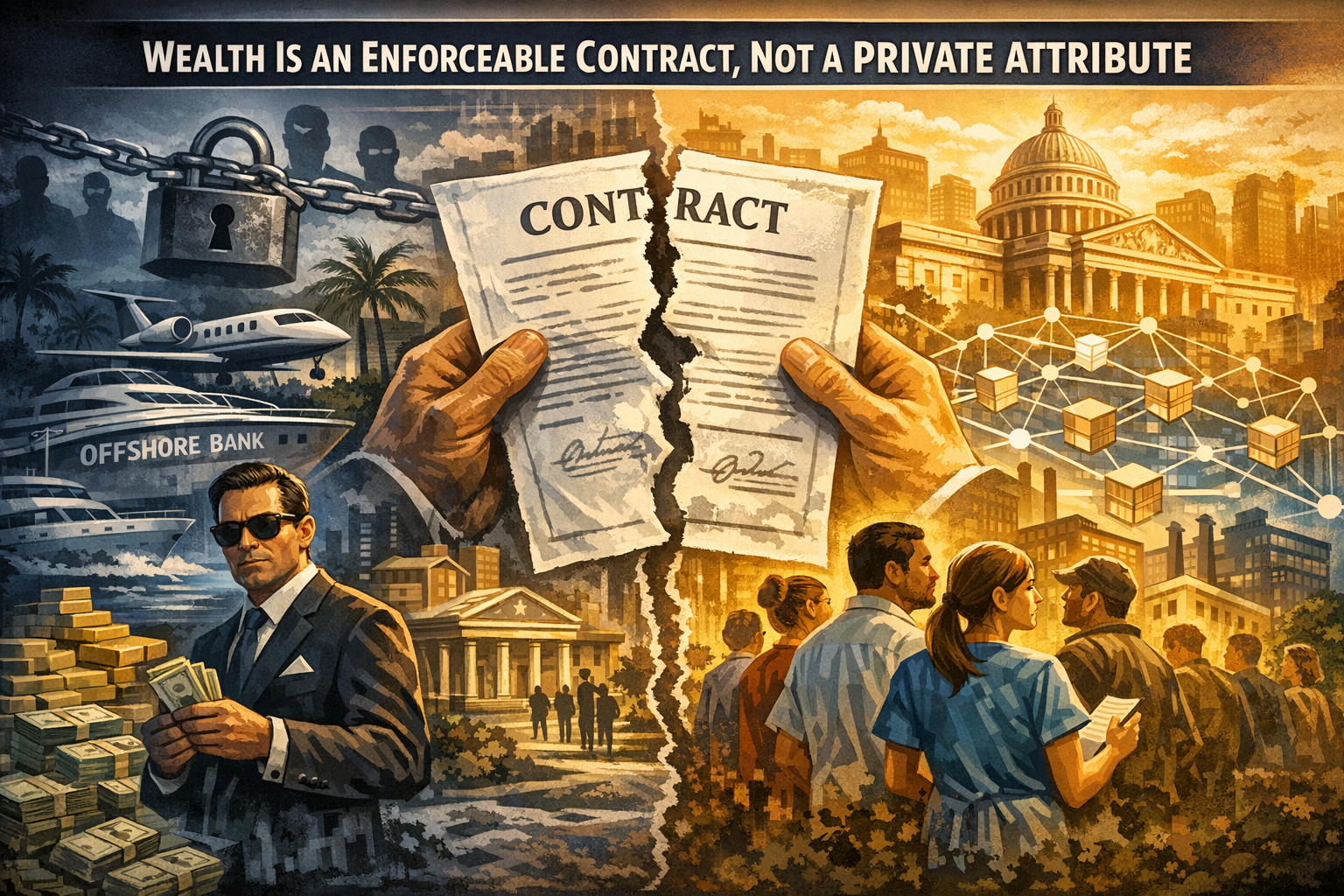
The Fiction We Accept
We have long accepted a peculiar fiction: that how much money a person holds is, in some meaningful sense, their private business.
This assumption underwrites banking secrecy laws, offshore accounts, and the fierce resistance to financial transparency proposals around the world.
But the assumption is wrong.
A clearer look at what wealth actually is shows that “financial privacy,” as we usually talk about it, is less like protecting a diary and more like hiding the terms of a contract from one of its parties.
Wealth Is a Claim
Wealth is not a personal attribute like a medical diagnosis or a private belief. It is a claim. Specifically, it is a claim against other people — a promise that in exchange for this number, other people will provide you with goods, labor, and services.
Money exists only because a community has agreed to honor it. Every dollar, euro, or satoshi in a wallet represents an outstanding obligation the collective has promised to fulfill.
And that collective is not an abstraction.
By “society as counterparty,” we mean something very concrete: every single person from whom you could, in principle, demand goods or services with that money. Your wealth is a bundle of enforceable expectations about what their future labor, housing, food, care, and attention can be turned into on your behalf.
Once you see wealth this way, the idea that its magnitude and movement should be entirely hidden from those same people stops looking like privacy.
It starts looking like fraud.
“You cannot hide a contract from one of its own parties.
That is not privacy — that is fraud.”
The Contract You Cannot See
Imagine I hold a legally enforceable debt against you — a claim that entitles me to seize your assets if you do not pay. Now imagine that both the existence and size of that claim are secret from you.
This is not a “private” arrangement. It is a void one. A contract concealed from one of its signatories is not a contract in any morally meaningful sense. If you are on the hook, you have every right to know that you are on the hook.
Wealth operates the same way.
When a person amasses billions in an offshore account, they are not just hiding a number. They are hiding the scale of the claims they hold over everyone else’s productive capacity. They are obscuring the degree to which they can shape prices, property markets, political influence, and access to resources.
Society — understood as the set of people whose work and goods can be bought with that money — is the counterparty to every claim of ownership. If those people are to make sense of the conditions that govern their lives, the large claims that structure those conditions cannot be invisible to them.
Financial secrecy, at scale, is not a right to be left alone.
It is the right to accumulate and deploy social power without the knowledge or consent of those over whom that power is exercised.
The Wrong Category
Part of the confusion comes from importing intuitions from domains where privacy is straightforwardly justified.
Your medical history involves deeply personal information. Your sexual life involves only you and the consenting adults you choose. Your inner religious convictions, your private diary — these are not claims on others. They may affect how you live, but they do not directly encode enforceable obligations on the time and resources of everyone around you.
Wealth is different.
To treat wealth like a medical record is to collapse two categories that should never have been conflated:
- Information about what you are
- Information about what you can demand from others
That distinction matters.
Defending the privacy of your medical history is protecting you against unjust intrusion into your vulnerabilities. Defending the “privacy” of your wealth is, in practice, defending your ability to hold and exercise large-scale claims over others without their informed awareness.
The Asymmetry We Already Have
Here is the real scandal: this “privacy” is not distributed equally.
Ordinary wage earners are nearly transparent already — but not to their fellow citizens. They are transparent downward, to corporations and the state. Their income is reported automatically. Their purchases are logged by payment processors. Their accounts are monitored for “suspicious activity.”
The wealthy, by contrast, enjoy a bespoke architecture of opacity: shell companies, trusts, special vehicles, friendly jurisdictions. Their actual claims on society are scrambled across entities and borders in ways that make it effectively impossible for the public — and often regulators — to see the true picture.
The scandal is not that we lack financial privacy.
The scandal is that what we call “financial privacy” operates almost entirely as a one-way shield for concentrated power.
What Blockchain Actually Threatens
Debates around cryptocurrency are usually framed as a trade-off between transparency and privacy. The public ledger is painted as a surveillance tool; anonymous wallets are cast as a civil liberty.
This framing is backwards.
A fully public, identity-linked blockchain would not be a surveillance system in the conventional sense. It would be the most symmetric financial transparency mechanism ever built.
No hidden offshore accounts. No quietly parked billions. No central bank moving funds in the dark. Every large holding, every significant transfer, visible in near-real time to any citizen with an internet connection.
“The real threat to entrenched power is not anonymous crypto.
It is fully identified public crypto — because then no one,
including governments and billionaires, could hide anything.”
Compare this to the current system.
The Panama Papers and Pandora Papers did not expose crimes committed with public ledgers. They exposed how the existing banking system, under the banner of “financial privacy,” created an infrastructure for legal and quasi-legal concealment. The entire apparatus of offshore finance depends on the opacity of private ledgers.
Central banks and treasury departments already move enormous sums with negligible public visibility. Corporate slush funds, political bribery, insider enrichment — none of this requires cryptocurrency. It thrives on the simple fact that, for those at the top, the books are never fully open.
A public, identity-linked ledger is not an escalation of surveillance.
It is a redistribution of it.
Who Sees Whom
Today, the authority — the state, the banks, the platforms — already knows nearly everything about almost everyone’s financial behavior.
The question is not whether financial data exists and is used.
The question is: Who knows more now, and who should learn more?
Right now, a governor can in principle track every financial move of a citizen. A citizen cannot track even a fraction of the governor’s financial entanglements.
The gaze is one-way.
Public crypto, if designed with identity and universal access, flips that logic — from asymmetric transparency to symmetric transparency.
The Anonymity Contradiction
There is a tension at the heart of proposals for anonymous financial systems. Many people want both:
- A ledger that guarantees transparency and accountability
- Strong anonymity that severs holdings and transactions from identity
But a single unidentified wallet in a transaction chain breaks the entire accountability structure. If one participant can hide their identity while others cannot, the ledger’s promise of transparency becomes selectively true — and therefore meaningless for public oversight.
This is not a technical inevitability. It is a design choice.
The original vision of Bitcoin was built around distrust: a “trustless” system requiring no central authority and no real-world identity. On its own terms, that vision is coherent. It is a proposal for money whose legitimacy does not depend on the state, and whose ownership is represented by cryptographic control, not legal title.
What it cannot simultaneously be is a system that delivers public, democratic, upward-facing accountability.
A trustless, anonymous system is, almost by definition, a system where large-scale claims on society’s future can be accumulated without the public ever having a clear view of who holds them.
You can choose an anonymous, trustless financial order, or you can choose a transparent, accountable one.
You cannot have both fully at once.
That is a political choice, not a technical constraint.
Symmetry, Not Exposure
None of this implies that everyone must know everything about everyone else, down to every minor purchase. There are legitimate reasons to protect people from being targeted, coerced, or stalked based on their finances.
But those concerns do not justify hiding system-shaping claims from the very people they shape.
The crucial distinction is between:
- Opacity: no one sees clearly
- Asymmetric transparency: the powerful see everyone else, but not vice versa
- Symmetric transparency: everyone can see the structure of claims that govern them
We already live under asymmetric transparency.
The state and major corporations operate with near-X-ray vision downward. The question is whether we normalize this imbalance, or whether we insist that whatever level of visibility exists should apply upward as well — to large holders, public officials, and institutions whose decisions affect millions.
A public ledger tied to verified identities, at least above some threshold of significance, would not be a machine for micromanaging private lives. It would be a mechanism for restoring equality before the ledger — the same principle we claim to apply before the law.
In such a system, the billionaire’s holdings would be no more and no less visible than the balances and flows of the government that regulates them.
That is not surveillance.
That is basic reciprocity.
The Social Nature of Wealth
The case for financial transparency does not rest on a sour view of individuals. It rests on a sober understanding of what wealth is.
Wealth is social. It is created collectively, stabilized collectively, and honored collectively. It confers the ability to redirect collective effort and resources at scale. It changes who can live where, who can access care, who can take risks, who can influence political outcomes.
Hiding large accumulations of this power from the people subject to it is not a harmless preference. It is a structural decision about who gets to understand — and therefore contest — the forces shaping their lives.
To claim that your wealth is purely your business is to claim that the claims you hold against everyone else’s future do not concern them.
That is not a plausible position.
It is a refusal to acknowledge the contract you are already enforcing.
Conclusion
The most radical proposal in finance today is not a new asset class or a faster payment rail.
It is the simple idea that the ledger should be legible to everyone whose obligations it encodes.
Not as voyeurism. Not as punishment.
As the minimum standard of honesty we owe each other, when we bind our futures together through money.