What This Inquiry Is About
Across history, people have tried to understand why meaning collapses, why agency feels constrained, and why suffering often seems normalized rather than questioned. Explanations vary: personal psychology, social pressure, economics, biology, culture, or simple misfortune.
Yet some experiences appear with surprising consistency across cultures and eras. These repetitions invite a careful question—not a conclusion, but an inquiry:
If human consciousness were being shaped in consistent ways, what observable patterns would we expect to find?
This framework does not ask you to accept a belief. It asks you to observe patterns carefully, patiently, and without rushing to interpretation.
The goal is not to explain why something happens yet—but to understand what is happening with greater clarity.
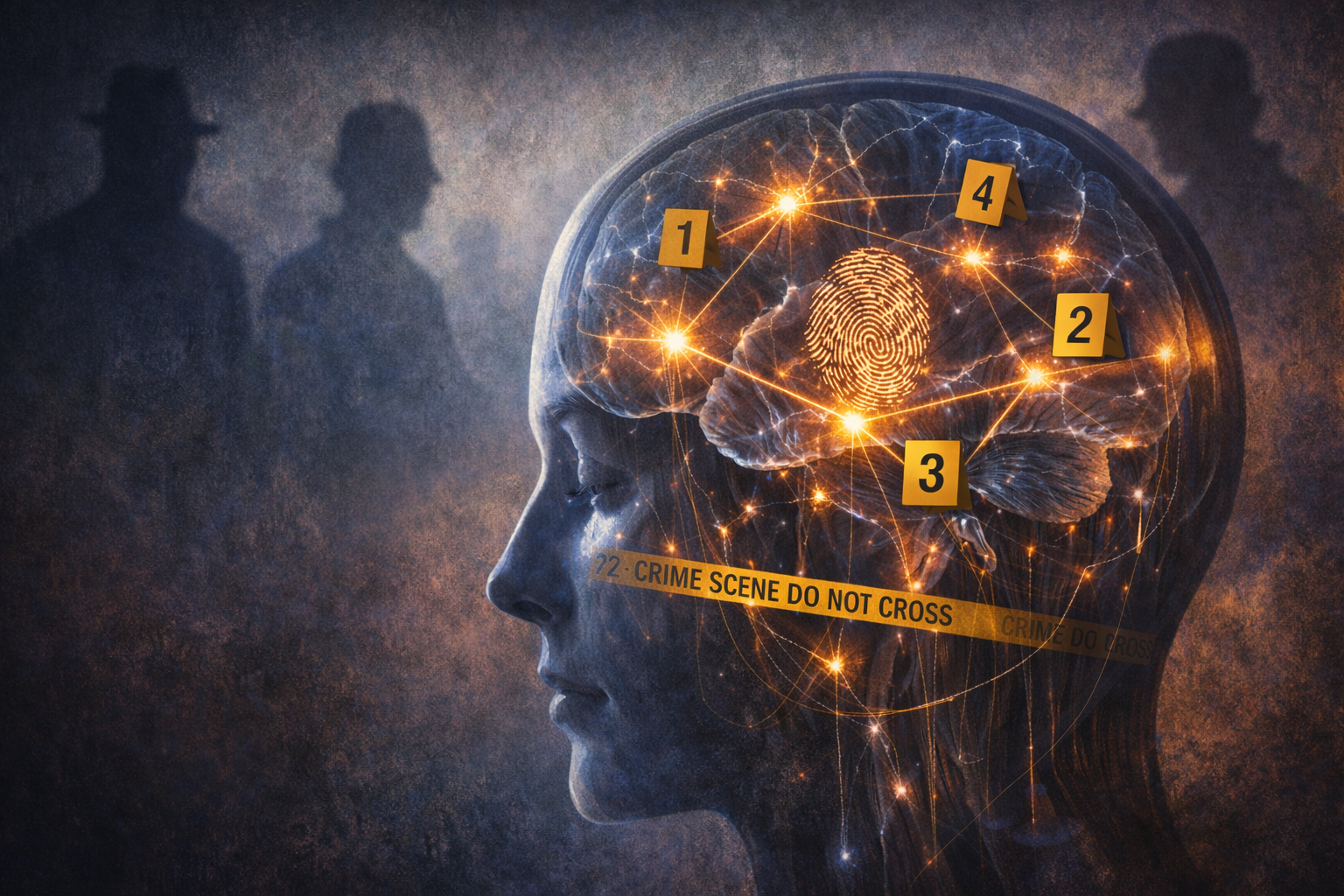
1. The Mind as an Evidence Site
Most psychological models focus on helping individuals adapt, heal, or function. That work is valuable and necessary.
Consciousness Forensics takes a different stance. It treats inner experience as data, not as a defect.
- Your thoughts are not assumed to be correct or incorrect
- Your reactions are not framed as pathology
- Confusion is not treated as failure
Instead, internal responses are observed as signals.
The central question becomes:
What conditions tend to produce this pattern of thought, reaction, or meaning?
This is similar to how investigators document a site before forming conclusions. Interpretation comes later—after patterns are clearly mapped.
2. Repeating Patterns of Influence
If consciousness is shaped rather than purely spontaneous, that shaping should leave consistent traces. Below are three commonly reported patterns that warrant careful observation.
These are not diagnoses. They are not proof. They are candidate indicators worth studying.
Pattern 1: Defensive Reactions to Fundamental Questions
Often observed as:
- Strong emotional reactions to basic existential inquiry
- Sudden shutdown, dismissal, or agitation when questioning assumptions
- A sense that curiosity itself is somehow unsafe
Why it matters: Curiosity usually produces exploration, not threat responses. When inquiry reliably triggers defense rather than reflection, it suggests a boundary worth examining.
Pattern 2: Normalization of Reduced Agency
Often observed as:
- Control framed as “just how reality works”
- Powerlessness reframed as maturity or realism
- Questioning limits treated as naivete
Why it matters: When reduced agency becomes socially reinforced as wisdom, it raises a forensic question: Is this acceptance freely chosen, or gradually conditioned?
Pattern 3: Systematic Reduction of Meaning
Often observed as:
- Human experience described exclusively in mechanical terms
- Purpose-seeking dismissed as illusion or weakness
- Meaning framed as subjective noise rather than a real signal
Why it matters: Meaning motivates protection. If meaning erodes, resistance often follows. Whether intentional or emergent, this pattern has measurable psychological effects and deserves careful study.
3. Why Patterns Matter More Than Stories
Individual experiences can always be explained in isolation. Patterns across populations are harder to dismiss.
The core analytical question is:
When similar cognitive and emotional patterns appear across unrelated cultures and conditions, what explains that convergence?
From a research perspective:
- Random variation predicts divergence, not repetition
- Cultural transmission explains some overlap, but not all
- Individual trauma accounts for cases, not global regularities
When outcomes remain stable across differing inputs, investigators look for structural influences rather than local causes.
This does not imply intent. It implies a need for deeper examination.
4. How Inquiry Itself Can Drift Off Course
Historically, investigations into power, influence, and human behavior tend to encounter predictable pressures—not always malicious, but structurally consistent.
Common risks include:
- Personalization: shifting focus from evidence to character
- Fragmentation: breaking systemic questions into harmless fragments
- Premature solutions: offering relief before understanding causes
- Authority capture: narrowing who is allowed to ask questions
None of these invalidate an inquiry—but they do distort it.
The response is not defensiveness, but methodological discipline:
- Clear criteria for falsification
- Transparent data collection
- Openness to being wrong
- Willingness to stop if evidence fails
An investigation that cannot fail is not an investigation.
5. Understanding the Role of This Framework
Consciousness Forensics does not replace therapy, philosophy, or social reform.
Its role is narrower:
- Therapy helps people heal
- Philosophy helps people interpret
- Policy helps people organize
- Forensics helps people observe what is happening before interpretation begins
Prevention requires understanding mechanisms, not just outcomes. Without that understanding, responses remain reactive.
6. The Forensic Stance
This framework prioritizes restraint.
What It Does
- Documents patterns without labeling individuals
- Separates observation from explanation
- Tracks reactions without assigning intent
- Publishes findings without prescribing action
What It Avoids
- Diagnosing people or societies
- Declaring causes prematurely
- Offering comfort in place of clarity
- Converting inquiry into ideology
The sequence matters. Observation comes first. Meaning follows later.
7. What Would Count as Success—or Failure
The framework succeeds if:
- Patterns dissolve under scrutiny
- Conventional explanations fully account for observations
- No convergence beyond chance is found
In that case, the hypothesis fails—and that is a valid result.
The framework gains credibility if:
- Convergence exceeds statistical expectation
- Patterns persist across contexts
- Existing models cannot fully explain outcomes
This would justify further investigation—not belief, but deeper study.
8. Ways to Engage
Researchers:
Design cross-cultural studies on agency, meaning, and response to inquiry.
Individuals:
Observe internal reactions without judgment. Record, don’t interpret.
Skeptics:
Stress-test the methodology. Propose alternative explanations.
Ethical observers:
Watch for overreach, unfalsifiable claims, or narrative drift.
Each role strengthens the integrity of the inquiry.
Conclusion: An Open Question, Not a Verdict
This framework does not claim that consciousness is being shaped. It asks how we would know if it were.
What patterns reliably distinguish intentional influence from random or self-generated disorder?
That question is answerable—but only through patience, scale, and restraint.
If nothing unusual is found, that clarity matters. If something consistent is found, that clarity matters even more.
Either way, observation precedes belief.
The Core Principle
Consciousness Forensics: Observe carefully. Document patiently. Interpret later.
The investigation remains open. The evidence—whatever it shows—comes first.