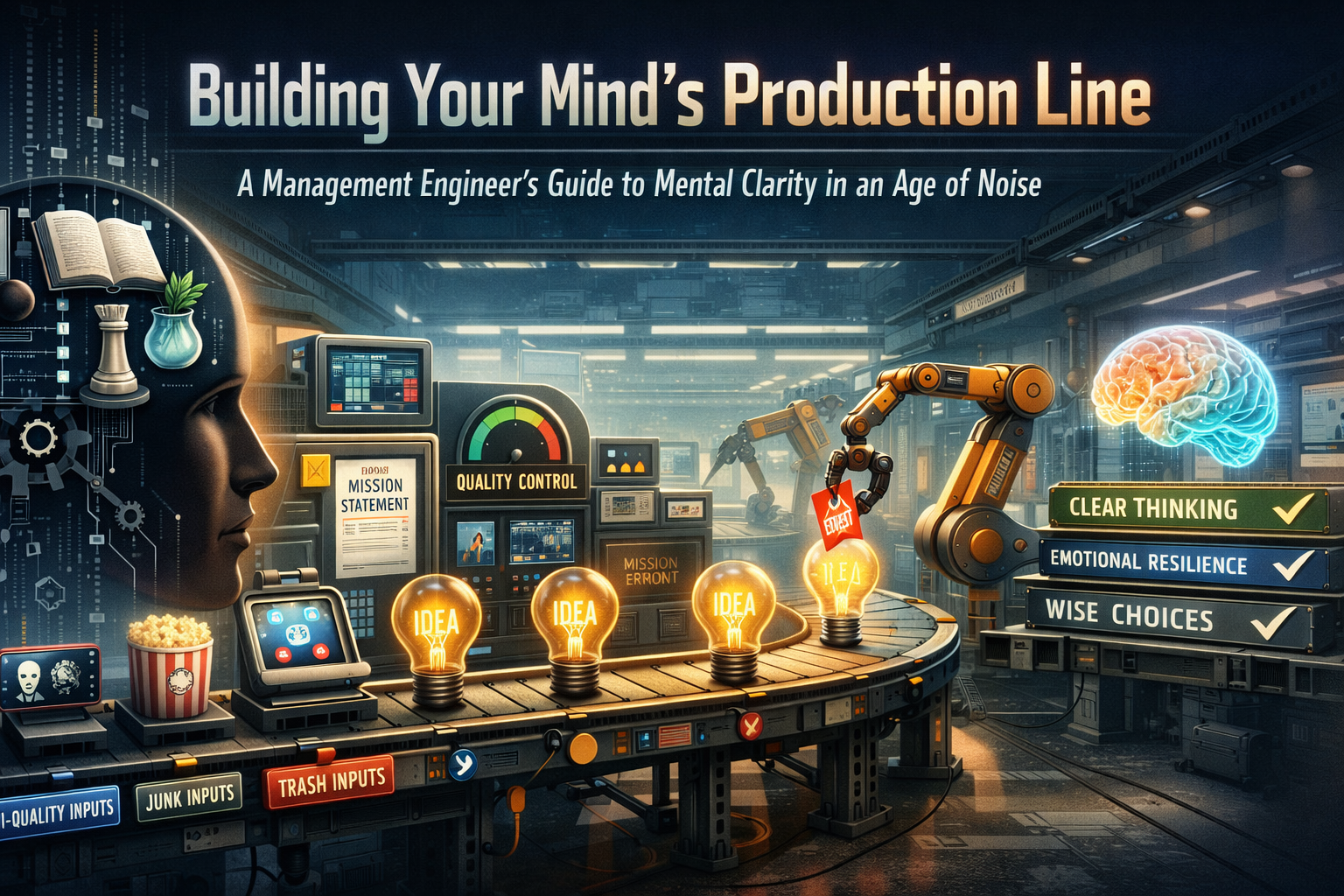
A Management Engineer’s Guide to Mental Clarity in an Age of Noise
We live in an environment designed to fracture attention. Algorithms compete for every millisecond of awareness, flooding us with stimuli meant to trigger immediate reactions.
Your mind is not a passive receiver. It’s a production line—constantly processing inputs and producing outputs: beliefs, judgments, emotions, decisions.
Yet most people run this production line without design specifications, quality control, or failure analysis. The result is predictable: cynicism, anxiety, shallow thinking, ideological capture.
What if we approached mental life the way a management engineer approaches a high-stakes production system? Systems design, Six Sigma, continuous improvement—these tools can reduce cognitive defects, protect signal integrity, and sharpen clarity.
Phase 1: Define the Product and Audit the Inputs
(The Mental Mission Statement)
Every production line begins with a precise definition of its desired output. Without this, optimization is impossible.
Define Your Mental Product
What do you want your mind to reliably produce? Not vague aspirations, but operational outputs:
- Clear thinking under pressure
- Emotional resilience without numbness
- Empathy without naivete
- Truth-seeking without cynicism
Example: A mind capable of disciplined judgment, moral clarity, and sustained attention in complex environments.
This definition becomes your quality standard.
Audit Your Inputs
Every conversation, book, film, post, and experience is raw material entering the system. These inputs differ radically in quality.
High-Quality Inputs Deeply challenging books, honest conversations, rigorous arguments, meaningful work, acts of service. These sharpen you.
Junk Inputs Mindless scrolling, shallow entertainment, gossip. Empty calories—you feel something, briefly.
Trash Inputs Propaganda, manipulative narratives, and content that normalizes unethical behavior, glorifies power without responsibility, or trains the mind toward apathy, cruelty, or passivity.
No production system can output excellence while ingesting toxic raw materials.
Phase 2: Design the Mental System
(Architecture, Not Willpower)
Discipline alone won’t cut it. You need structure.
Implement 360-Degree Evaluation
Consuming without thinking is negligence. For any input, ask:
- What is the surface message?
- What assumptions are embedded?
- What incentives shaped this content?
- What values are being normalized?
- What consequences are omitted?
Call it dimensional awareness, not cynicism.
Narrative Component Analysis: Inspecting Incoming Stories
Most people consume stories as finished products. In this system, that’s the defect. Disassemble the package first.
1. Separate Problem from Solution A valid grievance does not justify a monstrous method. A monstrous method does not erase a valid grievance.
Example: A character seeks justice for a murdered family (valid grievance) by torturing innocents for information (monstrous method). Both facts remain true.
Most narrative pressure happens when these are fused—when opposing the method is framed as denying the problem, or when the problem is used to excuse the method.
Ask: If I swapped the method for an ethical one, would I still care about the problem this much?
2. Separate Attributes from Role Judge actual traits, not the “hero” or “villain” label.
- A protagonist who lies and manipulates does not become honest just because they’re fighting evil.
- Honesty and competence do not become vices just because the antagonist has them.
Ask: If I listed this person’s behaviors without role labels, what would I think?
3. Audit Source and Incentives Every story comes from a position shaped by experience, values, and incentives.
- Who is telling this story?
- What incentives are in play? (Engagement metrics, funding, audience expectations.)
- What emotional state is this designed to produce? (Outrage, tribal solidarity, fear.)
Ask: What does this want me to feel, and why?
4. Test the Opposition (Advanced) Can you articulate the opposing view in a way its actual proponents would recognize?
If not, you don’t understand the conflict well enough to let it reshape your beliefs.
Quality Check A narrative passes inspection when you can:
- Judge the problem and method separately.
- List traits independent of roles.
- Name the source’s likely incentives.
- State the opposing case competently.
If a story resists this analysis—if it fuses problem and method, turns virtues into vices through labels alone, or makes the opposition unthinkable—that isn’t complexity. Within this framework, it’s a defect in the input stream.
Quality Control for the Mind
Borrow a page from manufacturing: define cognitive defects clearly, then reduce exposure pathways.
- Emotional manipulation
- Loss of empathy
- Ideological rigidity
- Passive consumption
- Echo-chamber reinforcement
Then reduce exposure pathways. If a piece of content glamorizes unethical behavior without reflection or counterbalance, that is not “complex art”—it is a defect attempting to enter the system.
Build Circuit Breakers
High-functioning systems fail safely.
The Hard Stop When content overtly manipulates, normalizes corruption, or rewards shallow thinking, disengage immediately.
The Mandatory Pause Insert a delay before reacting to emotionally charged inputs. Give your brain a beat before it reacts.
The Mute Button Constant noise—humor, outrage, drama—degrades signal quality. Silence is maintenance.
Phase 3: Operate and Continuously Improve
(Execution Under Pressure)
A well-designed system still requires courage to run—especially when social environments reward the opposite.
Accept the Cost of Quality
In a culture that celebrates noise, restraint looks like dullness. Depth looks like seriousness. Discernment looks like arrogance.
That’s the price of non-conformity.
Allow Controlled Junk Consumption
Fatigue happens. Curiosity happens. The difference between failure and control is awareness:
- Know it is junk
- Do not rationalize it
- Do not let it become the default
This is a controlled outage, not a system collapse.
The Asymptotic Goal: Functional Immunity
You’re not aiming for moral purity or asceticism.
You’re aiming for the point where low-quality inputs lose their appeal—not because they’re forbidden, but because they no longer register as rewarding. When the system is well-tuned, “guilty pleasures” stop being pleasurable.
The Outcome: Cognitive Sovereignty
Running your mind like a production line does not make you mechanical. It makes you intentional.
You move from passive consumption to architectural control. From reaction to judgment. From noise exposure to signal integrity.
In a world optimized for distraction and drift, clarity is rare. That makes it valuable—and ethical.