You’ve probably had this experience.
You finish a show or a movie, you can’t stop thinking about it, and you’re left with a strange feeling you can’t quite name. On paper, the story “condemns” certain behavior—but somehow you walk away admiring the people who do it. Or a series keeps telling you “violence doesn’t solve anything,” while also making sure violence is the only thing that ever works.
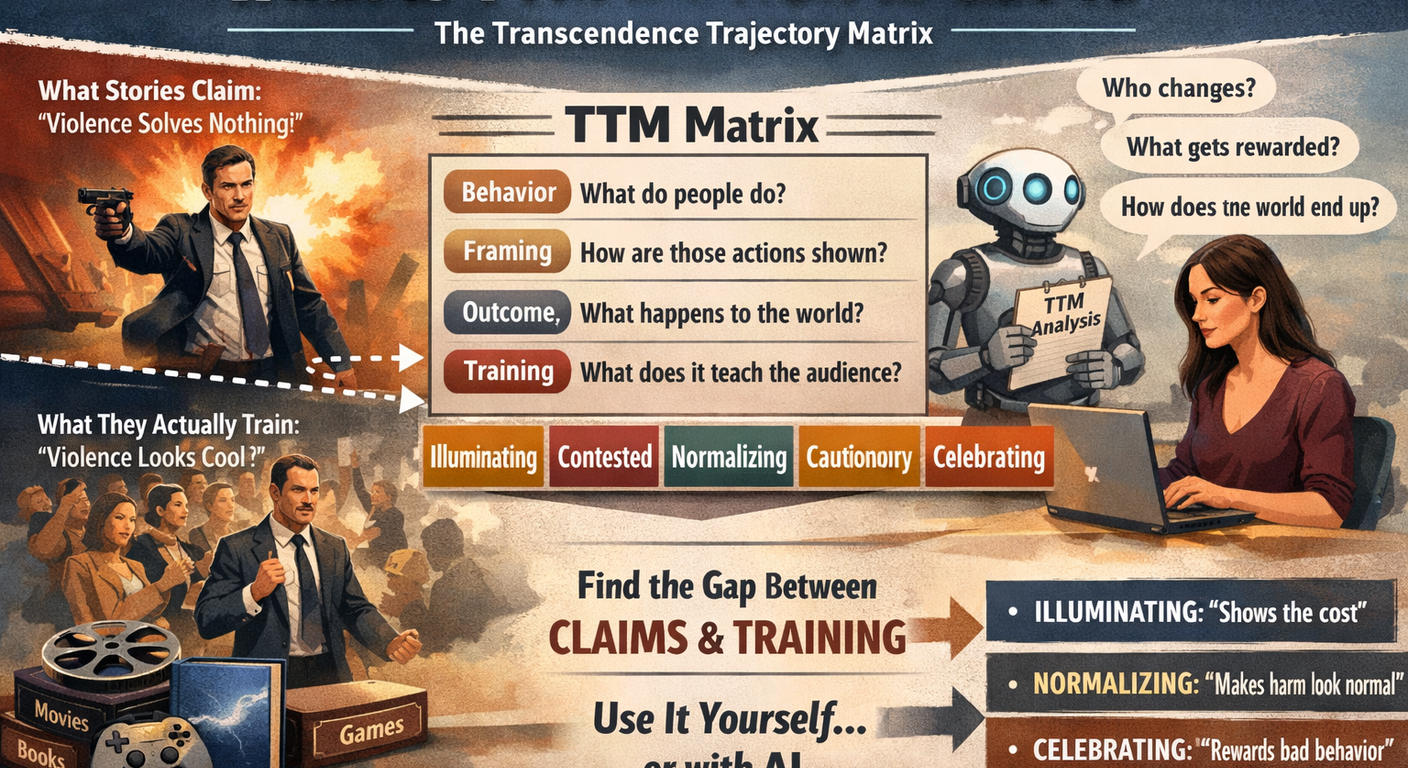
The Transcendence Trajectory Matrix exists for exactly that gap: the distance between what a story says and what it trains you to feel is normal, necessary, or admirable.
TTM is not a moral police. It doesn’t tell you what you’re allowed to enjoy. It’s a way of keeping the receipt—looking at what actually happens on screen, how it’s framed, and what kind of habits that builds in your own mind.
You can read it as a full framework. You can treat it as a mental checklist when you watch something. Or you can literally copy it into an AI and ask it to evaluate anything you’ve seen.
This is a guide to doing all three.
What TTM Actually Is
The Transcendence Trajectory Matrix is a systematic framework for analyzing narratives: films, TV series, novels, games, even podcasts or YouTube essays.
At its core, it asks four questions:
-
What do people do?
Not what they claim, not what they feel—what actions do they actually take? -
How does the story treat those actions?
Does it reward them, punish them, aestheticize them, shrug at them? -
What happens to the world by the end?
Is the system more honest or more corrupted? Safer or more brutal? -
What does that combination train in the audience?
What starts to feel normal, inevitable, cool, or pointless after you’ve absorbed this story?
Everything in the full TTM framework is a more precise way of answering those questions without getting lost in vibes or personal bias.
The philosophy is simple:
- Art is art. You’re allowed to love anything.
- We’re just keeping the receipt. We track what the story actually does to your expectations and instincts.
- Subject matter ≠ endorsement. Depicting darkness is not the same as being a dark work.
The Split That Makes Everything Clearer
Most arguments about “problematic” media blur together three different things. TTM deliberately separates them:
| Layer | What It Captures |
|---|---|
| Behavior | What actions actually happen |
| Framing | How the narrative presents those actions |
| Alignment | Whether the framing matches the behavior—or tries to spin it |
A few examples:
A character lies constantly.
- Behavior: high deception count.
- If the show treats them as witty, admirable, always rewarded—that’s one kind of framing.
- If it treats them as tragic, self-destructive, ultimately alone—that’s another.
A violent act saves the world.
- Behavior: violence is still violence; it gets counted.
- The question isn’t “was it justified?” but “what does the story teach about when violence is on the table and what it costs?”
By separating these layers, TTM can say things like:
- “This story shows a lot of harm, but it’s Illuminating—it makes the costs visible and doesn’t glorify it.”
- “This story Normalizes a pattern—it keeps rewarding the behavior that destroys everyone else.”
- “This story is Contested—it doesn’t fully decide, it pulls you in two directions.”
The point isn’t to cancel the work. It’s to know what it’s training.
The Five Functions
After running through its analysis, TTM classifies what a narrative does to its audience using five labels:
| Function | What It Means |
|---|---|
| Illuminating | Shows dark mechanisms without reward. Darkness serves insight. |
| Cautionary | Shows costs clearly. Harmful patterns lead to visible consequences. |
| Contested | Mixed signals, sustained tension. No clear training direction. |
| Normalizing | Minimizes costs, rewards harm. Harmful patterns framed as practical or necessary. |
| Celebrating | Aestheticizes and rewards harm. Harmful patterns framed as cool or admirable. |
You don’t have to get the label “right.” The real gain is seeing the pattern at all.
What TTM Measures (Human Version)
The full framework uses precise metrics and acronyms, but you don’t need to memorize any of that to use the mindset.
At a human level, TTM cares about:
Character trajectories
Who grows, who collapses, who stays the same? Do people become more honest, more constrained, more abusive, more self-aware? Does a character ever turn the moral lens they apply to others back onto themselves?
World trajectory
Is the world, institution, or system in a better state at the end than at the beginning? The same? Much worse? Has a “temporary compromise” quietly become the new normal?
What actually works
When conflicts are resolved, what methods usually succeed? Violence? Deception? Honest dialogue? Walking away? Whatever wins most is what the story is training as “effective.”
How the audience is nudged
Who gets the heroic music and flattering camera angles? Whose perspective you’re asked to inhabit? Which types of people are mocked, sidelined, or coded as pathetic?
Cost distribution
Whose choices cost whom? Does a character’s arc improve while the people around them pay? Are some characters protected from consequences while others are loaded with punishment?
Using TTM as a Mindset
You can run a “TTM-lite” pass on any movie or episode in five minutes.
After the credits roll, ask yourself:
-
Who changed, and in which direction?
- Who became more honest, more responsible, more self-aware?
- Who became more cynical, more violent, more numb?
- Who stayed the same while everyone else paid?
-
What did the story reward?
- Who got power, status, safety, or admiration by the end?
- Which methods “worked” most often?
- Did the story treat certain destructive patterns as sexy, witty, or necessary?
-
What happened to the world?
- Is the overall system more fair, more honest, more open by the end?
- Or did everyone just learn to live with a corrupted equilibrium?
-
What is this training me to expect?
- “If you tell the truth, you’ll be destroyed”?
- “Real adults learn to be ruthless”?
- “Institutions can’t change, only burn”?
- “Kindness is naive; detachment is wisdom”?
Once you’ve answered those, give the story a rough “function” label in your own words:
- “This is basically a warning.”
- “This is giving me permission to be cynical.”
- “This is forcing me to think, not training me either way.”
- “This is selling me on a certain kind of ruthlessness as cool.”
That’s you doing TTM informally. No spreadsheets required.
Letting AI Do the Heavy Lifting
If you want the full analysis without doing all the counting and cross-checking by hand, you can delegate the mechanical part to an AI assistant.
The basic idea:
- You keep the judgment.
- The AI does the bookkeeping.
Here’s how:
Step 1: Get the Framework
Go to honibis.com/frameworks/ttm and copy the full framework text.
Step 2: Give It to the AI
Paste the framework into your AI of choice (Claude, ChatGPT, Gemini, whatever you use) and say:
“Here is the Transcendence Trajectory Matrix (TTM), a narrative analysis framework. Read it carefully.”
Step 3: Ask for Analysis
Once it confirms understanding, make your request. Here’s the kind of prompt that works well:
“Analyze Lord of the Rings (the film trilogy) deeply with TTM. Show me a readable HTML report. Apply all optional metrics.”
Or:
“Run a full TTM analysis on Season 1 of Breaking Bad. Include character arcs, CRM (what methods succeed), system trajectory, and the final Narrative Offer classification. Format as a clean report.”
Or more casually:
“What does Game of Thrones train viewers to expect about power, using the TTM framework?”
Step 4: Argue With It
You’re still the critic. When the AI returns its analysis, skim it and ask:
- Does it actually count what happens, or is it repeating marketing lines?
- Is it confusing character speeches with behavior?
- Is it missing parts of the story you remember clearly?
If something feels off, push back:
“You’re giving too much weight to what the characters say. Reclassify, focusing only on actions and outcomes.”
“You’re ignoring that violence solves almost every major conflict in this story. Re-run with attention to what actually works on screen.”
“You marked this as Cautionary, but the protagonist ends up with everything they wanted. Explain or revise.”
The AI becomes your calculator and note-taker. You remain the one deciding whether the result feels honest.
What You Get Back
When you ask for a full TTM analysis with all metrics, you’ll typically receive:
- Character arc classifications for each major character (Transcendent, Degradation, Stabilization, etc.)
- Behavioral counts tracking violence, deception, coercion, and other patterns
- System trajectory showing how the world changed from beginning to end
- Conflict Resolution Method (CRM) breakdown showing what percentage of conflicts were solved by force, dialogue, deception, or withdrawal
- Audience Alignment Signal analysis of how framing nudges viewer sympathy
- Distortion Coefficient measuring the gap between what the story shows and how it frames what it shows
- Final Narrative Offer classification with confidence level
For a work like Lord of the Rings, you might see something like:
Functions as Illuminating | Transcendent (Frodo, Aragorn) | CRM: Force 65% → victory, but with visible cost | DC: LOW
Which tells you: this story uses a lot of violence, but it shows the costs clearly, the protagonists genuinely grow, and the framing matches the behavior. It illuminates rather than celebrates.
Compare that to a different analysis:
Functions as Normalizing | Degradation (Walter White) | CRM: Deception 70% → success | N+ | DC: HIGH (Gaslighting)
Which tells you: this story shows a character becoming worse, but the framing makes it feel cool and justified; deception is consistently rewarded; moral categories are undermined; and there’s a significant gap between what’s shown and how it’s sold.
Both are valid stories. TTM just helps you see what they’re doing differently.
Running TTM on Things You’ve Already Seen
Once TTM is in your toolkit, almost anything you’ve watched becomes new material.
Revisit something you love.
Ask: “Why does this still work on me?” Maybe it’s genuinely cautionary. Maybe it’s celebrating a pattern you don’t endorse but find compelling. Seeing that clearly often deepens, not diminishes, your relationship with it.
Interrogate the “guilty pleasures.”
Instead of judging yourself for liking them, keep the receipt: “This show makes ruthlessness feel brilliant and sexy.” That doesn’t mean you have to stop watching. It just means you’re awake while you do.
Compare two works with the same subject.
Two crime dramas about similar characters. With TTM, you can say: “Both show similar behavior, but one is Illuminating and one is Celebrating, because of how they handle costs, framing, and what ultimately works.”
Look at a whole genre.
After you’ve run TTM on a few superhero films, or prestige antihero dramas, patterns emerge: What always works? Who always pays? What type of person is always admirable, and what type is always ridiculous?
At that point, you’re not just watching a story. You’re watching the training loop you’re immersed in.
Why Bother?
Most people feel the effects of stories long before they can name them.
- You notice you’ve become more cynical, but it feels like “reality.”
- You feel suspicious of idealism, but you’re not sure when that happened.
- You reflexively admire a certain kind of charisma, even when it’s destructive.
TTM is a way of putting language and structure around that shift.
Used lightly, it means:
- You notice what’s being normalized.
- You notice what’s being aestheticized.
- You notice when the story’s stated morality doesn’t match what actually works on screen.
Used more fully, it gives you a disciplined way to track behavior, framing, and outcomes—with enough rigor that your analysis doesn’t collapse into “I liked it / I didn’t.”
You’re not required to turn every evening of TV into homework. But having this lens available means that when something really gets into your head—for good or for ill—you have a way to see how.
Quick Start
If you want to begin gently:
- Pick a single film or season you know well.
- After watching, answer the four questions: behavior, framing, world outcome, training.
- Give it your own “function” label.
If you want to go deeper:
- Visit honibis.com/frameworks/ttm.
- Copy the framework into an AI.
- Ask it to analyze something you’ve seen, request an HTML report, and argue with it until the result feels honest.
Example prompt to try right now:
“Analyze [your favorite show] deeply with TTM. Show me a readable HTML report. Apply all optional metrics.”
Either way, you’re stepping out of passive consumption and into conscious engagement.
Art can be anything. You’re still free to love it.
TTM just helps you see what it’s doing in you while you do.
The full Transcendence Trajectory Matrix framework is available at honibis.com/frameworks/ttm.