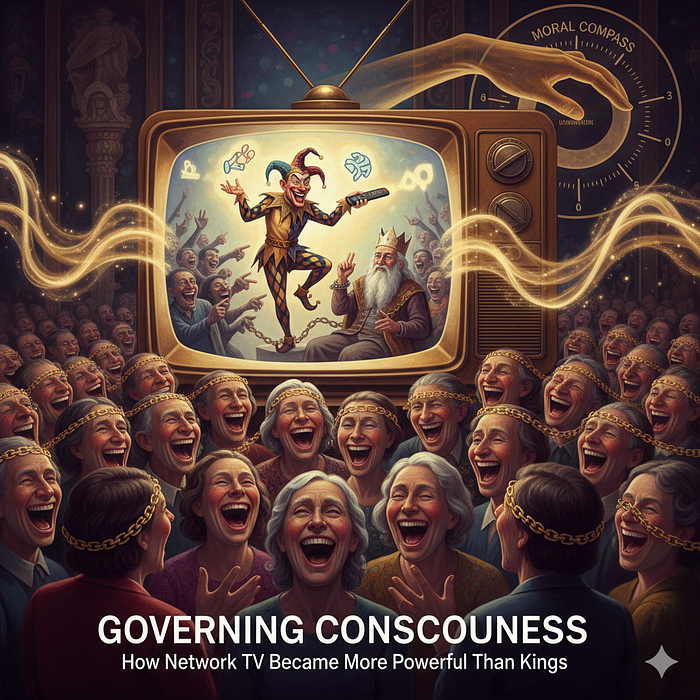
The surrender to a moral transgression often happens in a single sound: laughter. Not the laughter of shared delight, but something more ambiguous—a chuckle that says, I saw what you did, and my response was amusement. It is a kind of emotional contract, bypassing conscious judgment, issuing permission for what just occurred.
This distinction matters more than we typically acknowledge. Laughter is not just an expression of joy; it’s a high-stakes social signal that indicates alignment. When genuine, it affirms connection and shared values. But laughter can also be engineered—deployed to dissolve tension and override moral discomfort before it fully forms.
The sitcom laugh track offers the clearest example of this mechanism in action.
The Geometry of Engineered Laughter
Comedy always has a direction. There is a source (the one framing the joke), a target (the one diminished by it), and an audience (whose alignment is being sought). The laugh track eliminates ambiguity about where to stand. It positions you alongside the source, against the target, before you’ve had time to decide for yourself.
When laughter follows a humiliating moment, rationalization happens instantly. What might have registered as cruelty is reframed as harmless fun. The moral clarity doesn’t get debated—it gets contaminated.
This is not an abstract concern. Humiliation has always been a more effective tool of control than overt force. Torturing someone who represents higher values risks creating a martyr. But publicly degrading them—making them look foolish, petty, pathetic—erodes the authority of what they stood for. The betrayal itself begins to seem smaller. We didn’t destroy something noble. There was nothing noble there to begin with.
Once ideals are linked to ridicule, resistance loses its emotional fuel. Humiliation doesn’t just harm the person; it kills the idea attached to them.
Caricature as the Enabling Technique
The mechanism that makes this work is caricature. You take a morally sound trait and exaggerate it until it becomes grotesque. A person who values honesty is depicted not as truthful but as pathologically tactless. Someone with self-discipline appears not as controlled but as rigidly tyrannical.
The audience doesn’t reject honesty or discipline. They reject the distorted version presented to them. But the underlying virtue erodes quietly, associated now with social punishment rather than respect.
Modern sitcoms have refined this technique with remarkable consistency.
In The Big Bang Theory, Sheldon Cooper’s precision and adherence to principle are twisted into arrogance and social dysfunction. The audience is trained to laugh at his confusion and pain, rehearsing the rejection of the outlier rather than engaging with what he might represent.
In How I Met Your Mother and Two and a Half Men, the dynamic grows darker. Characters like Barney Stinson and Charlie Harper engage in manipulation and dehumanization of women—schemes, lies, emotional disposability. Yet the laugh track acts as a moral override, pairing these behaviors with the sound of joy. The audience learns to associate predation with charm, cruelty with wit.
Scale Changes Everything
Viewers are not passive. Many maintain critical distance. Comedy can be subversive, and plenty of people enjoy these shows without adopting their moral frames. Drawing a straight line from entertainment to tyranny risks false equivalence.
But structure matters. These were not marginal experiments. They were mass-distributed cultural products, heavily funded, reaching tens of millions repeatedly over years. Their patterns were not accidental; they were refined because they worked—because they made difficult behavior easy to laugh at.
Laughter is contagious. When paired consistently with humiliation or exploitation, it shapes what feels normal, charming, acceptable. This is a form of soft power. It doesn’t issue commands, but it trains emotional reflexes—how people perceive hierarchies, interpret cruelty, decide which violations feel trivial enough to ignore.
The creators of these shows influenced how young men viewed women, how society treated neurodivergence, what counted as wit versus abuse. That reach carried responsibility. Invoking audience agency alone feels insufficient when the medium actively shaped what audiences found funny in the first place.
What Carries Judgment
This is not an argument for censorship. Free expression remains intact under scrutiny. What comes into question is the habit of dismissing engineered laughter as harmless simply because it arrives wrapped in pleasure.
The distinction worth clarifying is between art that opens space for reflection and content designed to neutralize moral tension through emotional manipulation. One invites you to think. The other trains you not to.
A laugh can be a moment of connection. It can also be a psychological contract. Often it is both at once. The unsettling possibility is that the smallest sound—the briefest chuckle—may carry more moral weight than we are accustomed to noticing.