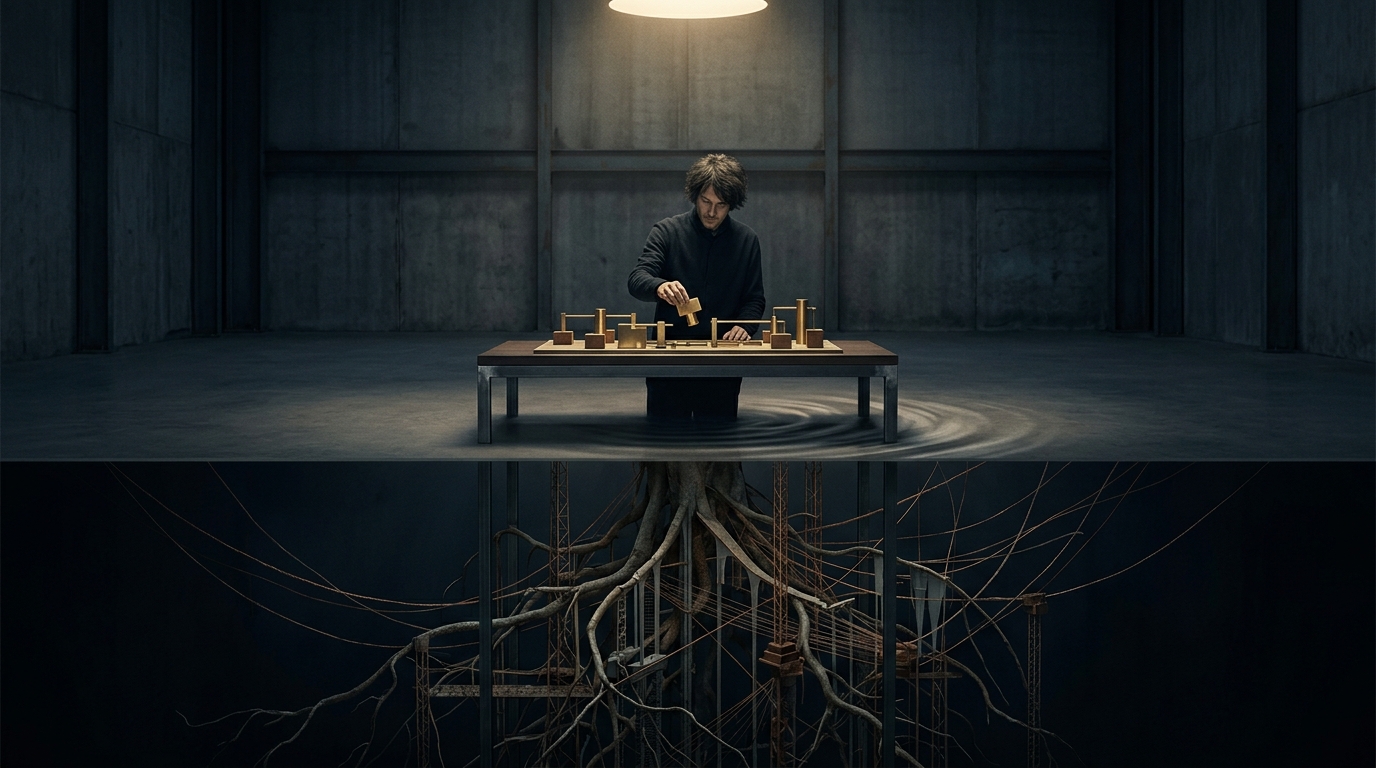
The Boundary of the Model
We often recognize intelligence by what it makes possible: someone understands a situation, finds an opening, and gets the result they want. The success is visible. The limits of the understanding behind it are not.
A person can become very good at getting results within a small part of reality without understanding much of what surrounds it. They know what to move, where to apply pressure, which obstacle can be bypassed. Each success makes that knowledge feel more complete than it is.
Eventually, two assumptions can begin to feel like observations:
If I can manipulate it, I understand it. If I cannot detect a consequence, no consequence exists.
But getting the result we expected establishes less than it seems to. It tells us that our understanding worked for that result, under those conditions. It does not tell us what else happened.
Power Asymmetry Is Not Comprehension
An older child can be strong enough to overpower an infant while understanding very little about the infant’s experience. The child can make something happen without knowing what that event means for the other person, or how long its effects might last.
That gap matters. The child’s understanding helps explain the action, but it does not determine the extent of its consequences. Those unfold in the infant’s life, not just in the older child’s account of what happened.
Technology gives us a far greater reach, but it does not automatically close the same gap. We can alter an organism, reproduce some of its processes, or end its life. Each ability demonstrates particular knowledge. None, by itself, establishes that we understand everything the organism is.
Evolution offers no final ranking that settles the question. Some birds use Earth’s magnetic field to help navigate. Spiders produce silk and build with it. Some bacteria survive conditions that would kill us. These are not incomplete attempts at being human. They are different ways of living, with histories and capabilities of their own.
Our ability to overpower them is real. The mistake is treating that ability as an answer to a different question: how much of their reality do we actually understand?
The Visible Interface
Sometimes the part we can reach comes to stand for the whole.
Someone gets past a security guard at the entrance to a building and concludes that its security has been defeated. At that moment, the conclusion seems justified: the obstacle is behind them, and they are inside.
But there may also be cameras, access records, alarms, and people who will examine those records later. Getting past the guard was a success at one level. Whether it was a success overall is still an open question.
There is a similar temptation in studying living things. We identify a stimulus, trace a nerve signal, and explain a response. That explanation may be accurate and enormously useful. The extra step comes when we can explain this response quietly becomes there is nothing else to explain.
Every measurement has a scope. A reading can tell us exactly what an instrument was designed to detect without settling questions outside that scope. This is not a failure of measurement. It is a limit on what follows from it.
Consciousness makes that distinction especially difficult to ignore. We can study the relationship between bodily processes and experience without having settled every question about the nature of experience itself. A complete physical account may ultimately explain it. The possibility that our account is missing something does not, on its own, establish a soul or a hidden world.
The security analogy cannot prove that such a hidden layer exists. What it exposes is the gap in the inference: access to one part is not evidence of having understood the whole.
The Wager Inside the Choice
That gap becomes practical when an action cannot be reversed.
Consider an encounter with an animal in which the benefit is simply amusement and lasting injury is a foreseeable possibility. The enjoyment is easy to picture. What happens to the animal is less accessible, especially when its experience is very different from our own.
Responses to injury, learning, and escape behavior can inform our judgment, though no single response proves subjective experience. The evidence differs between animals. Uncertainty here is not a blank space in which every possibility is equally likely; it is a reason to distinguish what the evidence supports from what we have merely assumed.
Suppose experience does have some continuity our present models do not capture. That would change the meaning of the encounter. But the supposition remains a hypothesis, not a consequence we can assign a probability or a price. An imagined possibility does not become a demonstrated danger just because it would be serious.
The stronger argument needs less. There is already a difference between a passing benefit and a lasting injury, and between choosing with good evidence and choosing because the unanswered questions have been counted as zero.
This does not make every irreversible choice irrational. Much of life is irreversible, and doing nothing also has consequences. The comparison depends on the benefit, the available alternatives, and the reasons for expecting harm. But where the benefit is slight and the possible loss is lasting, the claim that the choice is obviously worthwhile needs more support than nothing else is visible to me.
What looks like a simple preference can contain a substantial wager about how complete our picture is.
The Time Beyond the Decision
Part of that wager concerns time. A choice can make sense within the period we are considering and look entirely different just beyond it.
If someone knew they had only an hour to live, spending everything on that hour might make sense to them. If they actually had twenty years ahead, the same choice could leave them with a long aftermath they had never included in the decision.
Their reasoning might have been consistent. The assumption about how much future remained was wrong.
Something similar happens when an action meets no immediate resistance. We get the result we wanted, nothing visibly goes wrong, and the encounter feels finished. But finished for our purposes is not necessarily finished.
A debt can remain when no one is asking for repayment. Pollution can move slowly through groundwater before reaching a place where it is measured. A signed contract can appear to settle an agreement while leaving questions about coercion or capacity that later become central to a dispute.
These are ordinary cases with identifiable mechanisms. They do not prove that every action carries a hidden penalty. They show why a quiet interval cannot, by itself, settle the question. The significance of seeing nothing depends on whether we were looking in the right place, for long enough, with a reasonable idea of what there was to see.
What Cannot Be Put Back
Time also changes what it means to repair something. A replacement can serve the same purpose as a lost object. Restitution can settle a claim. Neither makes the intervening history disappear.
With a living being, the distinction is particularly sharp. Another organism is not a return of the one that died. Recovery from an injury is not a life in which the injury never happened. Something may be repaired without everything being restored.
This is where the limits of understanding stop being merely intellectual. A mistaken explanation can be revised. An action taken on its strength may not be reversible. We can discover what we overlooked without being able to recover what it cost.
Gravity is a familiar illustration: a person’s belief about a ledge does not determine whether it supports them. That tells us nothing about whether an unknown consequence exists. It tells us that, if one does exist, failing to anticipate it offers no protection.
What Our Confidence Depends On
The argument does not depend on a universe that rewards kindness or punishes cruelty. It concerns the distance between being able to do something and knowing what doing it entails.
Three distinctions run through it: control is not complete understanding; an immediate result is not the whole aftermath; and compensation is not reversal.
None supplies a rule for every choice. Together, they reveal how much can be left out of a decision that nevertheless feels completely rational. A person may know exactly how to obtain the result they want while knowing very little about what else their success sets in motion.
Someone may still consider the choice worth making. That is a judgment about what they want and what they are prepared to risk, not a discovery that the uncertainty has disappeared.
The choice remains theirs. Where their understanding ends is not necessarily where the event ends.