Our minds are driven by a complex interplay of forces that shape our thoughts, emotions, and behaviors. Understanding these mental drives is crucial for developing authentic self-awareness and conscious control over our actions.
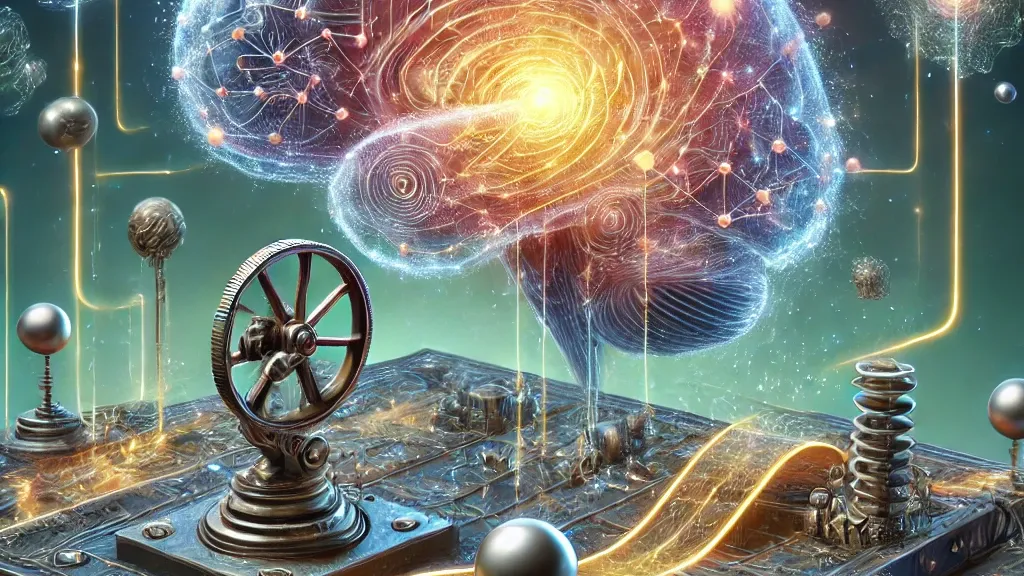
The Spectrum of Mental Drives
Mental drives function as energetic power points that direct, amplify, and potentially force action. They exist along a spectrum from primal to transcendent:
Instinctive Drives
At the foundation are our biological imperatives - hunger, thirst, sexual desire, and self-preservation. These drives, hardwired through millions of years of evolution, provide the basic motivational energy for survival. Research in evolutionary psychology demonstrates how these instinctive drives can subconsciously influence decision-making, often without our awareness.
Emotional Drives
Above instinctive drives lie emotional forces such as fear, anger, joy, excitement, and attachment. These drives evolved as sophisticated response systems that helped our ancestors navigate complex social environments. For example, fear evolved as a protective mechanism against threats, while joy motivates beneficial behaviors through reward.
Social Drives
Humans possess powerful drives toward belonging, status, and social connection. These drives manifest in our need for acceptance, recognition, and group identity. Social psychology research shows how these drives can override even basic survival instincts in certain contexts.
Mental/Cognitive Drives
At higher levels of complexity, we experience drives toward meaning-making, understanding, creation, and self-actualization. These drives propel intellectual curiosity, artistic expression, and spiritual seeking.
Conscious Drive
Conscious drive represents the highest evolution of human motivation—a transcendent force that operates beyond instinctive, emotional, social, and cognitive drives, manifesting as direct moment-to-moment awareness that transcends conceptual thinking.
The Tilt Game Analogy: Understanding Mental Drives
Imagine your thought process as a ball in a classic tilt game – the kind where a metal ball rolls across a maze-like board with various obstacles and targets. This analogy perfectly illustrates how mental drives function:
The Mechanics of Mental Drives
In this mental tilt game:
-
The Ball represents your thought or attention
-
The Board is your mental space
-
Tilt Mechanisms are your mental drives
-
Holes and Targets are potential actions or outcomes
When a thought (the ball) encounters a mental drive (tilt mechanism), several things happen:
· Direction Change: The thought is redirected toward specific outcomes
· Acceleration: The thought gains momentum and intensity
· Pathway Creation: Channels form, making similar future thoughts likely to follow the same path
For example, when a neutral thought like “I see food” encounters the hunger drive, it’s suddenly redirected and accelerated toward action-oriented thoughts: “I should eat that” → “I want that now” → reaching for food. Without conscious intervention, the ball follows the tilted path to its logical conclusion.
The Vulnerability of Unconscious Drives
When we lack awareness of our mental drives, we become vulnerable to both internal conditioning and external manipulation. This vulnerability manifests in several critical ways:
External Manipulation
If we cannot recognize and regulate our mental drives, we become susceptible to those who can insert ideas into our consciousness:
· Commercial Exploitation: Advertising leverages instinctive and emotional drives to create artificial needs and compulsive consumption patterns
· Media Influence: Entertainment and news content can hijack attention by triggering fear, outrage, or novelty drives
· Social Engineering: Digital platforms exploit social drives through variable reward systems that generate dopamine-driven feedback loops
In the tilt game analogy, external manipulators know exactly which parts of your board to activate to get the ball (your attention and decisions) to fall exactly where they want. They’ve mapped the tilt mechanisms of human psychology and can remotely activate them through carefully designed stimuli.
Addiction and Compulsion
Unregulated drives can develop into destructive patterns:
· Substance Dependence: Chemical dependencies often begin as attempts to satisfy emotional drives for comfort or excitement
· Behavioral Addictions: Activities like gambling, shopping, or social media use become compulsive when they activate reward systems tied to basic drives
· Thought Addiction: Even mental patterns like worry, rumination, or fantasy can become addictive when they temporarily satisfy underlying emotional drives
As neuroscientist Dr. Anna Lembke observes in her research on addiction: “The same brain mechanisms that help us pursue survival and reproduction can be hijacked, leading to compulsive engagement in behaviors that ultimately undermine our well-being.”
The Intersection of Drives and Vortexes
When drives activate, they generate mental and emotional energy that can either be consciously channeled or become entrapping vortexes:
From Drive to Vortex
As explored in “The Mind Vortex,” emotional loops begin when a potent trigger pulls our attention into a spiraling focus. Consider how a fear-based drive can transform into an anxiety vortex:
-
Trigger: A perceived threat activates the fear drive
-
Amplification: The initial fear generates worry-thoughts, which intensify the fear
-
Looping: The intensified fear generates more catastrophic thoughts, creating a self-reinforcing cycle
-
Dominance: Eventually, the vortex consumes mental space, narrowing perception and limiting response options
Returning to our tilt game analogy, vortexes occur when the ball enters a spiral-shaped path from which it cannot escape without intervention. The mental energy (ball) circles faster and tighter, unable to exit the loop. For example, a simple worry-thought might enter a depression-drive spiral, where each cycle intensifies the negative energy until all mental resources are consumed by the vortex.
This pattern applies across drive types. A healthy hunger drive can become a compulsive eating vortex; a natural sexual drive can transform into obsessive desire; and social drives can morph into approval-seeking addiction.
Conscious Drive as Vortex Prevention
Unlike other drives that easily generate vortexes, conscious drive serves as a stabilizing force that prevents harmful loops:
-
Contextual Awareness: Conscious drive maintains perspective, preventing the narrowing of attention that initiates vortexes
-
Integration of Opposites: It balances opposing forces (pleasure/pain, attachment/detachment) that might otherwise create oscillating vortexes
-
Present-Moment Anchoring: Its focus on the now interrupts the projections into past/future that fuel vortexes
-
Holistic Processing: It engages multiple brain networks simultaneously, making it more resistant to the single-channel fixation of vortexes
In our tilt game, conscious drive acts as a meta-controller - it allows you to see the entire board from above, notice when the ball is heading toward a vortex, and make calibrated adjustments to redirect it. Rather than being limited to automatic tilting mechanisms, conscious drive provides manual override capabilities.
Mental Space: The Foundation of Conscious Response
The quality and condition of our mental space determines whether drives propel us toward growth or entrap us in vortexes. Mental space functions as the medium within which consciousness operates.
Returning to our tilt game analogy, the board itself - its size, condition, and design - determines how effectively the game can be played. A cluttered, warped, or poorly maintained board makes controlled play nearly impossible, while a clean, well-designed board enables masterful navigation.
Mental Space as Soul Territory
The concept of mental space extends beyond cognitive territory into what many traditions consider “soul space” – the dimensionless dimension where our deepest nature resides. This involves:
-
Clearing Conditioned Patterns: Removing accumulated mental debris that obscures authentic being
-
Expanding Awareness: Cultivating the capacity to hold increasingly complex and subtle states of consciousness
-
Deepening Presence: Developing the ability to remain fully present with whatever arises
-
Integrating Shadow Elements: Bringing unconscious material into awareness so it no longer operates autonomously
-
Opening to Transcendence: Creating receptivity to dimensions of experience beyond ordinary consciousness
As contemplative teacher Adyashanti notes: “When we clear the mental space of its clutter and conditioning, we discover that what remains isn’t emptiness, but a profound fullness – the ground of being itself.”
The Conscious Routing of Drives
With sufficient mental space, drives no longer dictate behavior but serve as information for conscious decision-making:
-
Recognition: Noticing when a drive activates (“I’m feeling hungry/afraid/excited”)
-
Observation: Watching the associated thoughts and sensations without immediate reaction
-
Evaluation: Considering the appropriate response given current circumstances and values
-
Intentional Action: Choosing behavior that aligns with deeper purposes rather than momentary impulses
In tilt game terms, this represents the evolution from being a passive player (simply responding to the ball’s movements) to becoming both player and designer - consciously modifying the board’s tilt mechanisms while simultaneously playing the game.
Reverse Engineering: Tracing Actions to Their Origins
A powerful practice for developing mastery over mental drives involves backward analysis - examining completed actions to identify their mental triggers:
The Action Chain
Every action we take can be reverse-engineered to reveal its origins:
-
External Stimulus: What triggered the initial thought/feeling? (An image, comment, physical sensation)
-
Activated Drive: Which drive was energized? (Fear, desire, curiosity, etc.)
-
Thought Sequence: What thoughts followed the activation? (Interpretations, projections, memories)
-
Decision Point: Where was the moment of choice? (Often barely perceptible)
-
Action Implementation: How did the behavior manifest?
Using our tilt game analogy, reverse engineering means tracing the ball’s path backward from where it landed to identify which tilt mechanisms influenced its journey. This analysis reveals patterns: “I always end up in this hole when the ball starts from that corner and hits these particular tilt points.”
Through consistent practice of this reverse analysis, patterns emerge that highlight our particular vulnerabilities and conditioning. This awareness creates the foundation for future conscious intervention.
From Automatic Reaction to Authentic Action
The ultimate goal of understanding mental drives is not suppression but integration - bringing unconscious forces into conscious awareness so they can be channeled constructively rather than destructively.
Signs of Authentic Action
How can we distinguish between conditioned reactions and authentic choices? Authentic actions tend to:
-
Align with values: They reflect our deepest principles rather than momentary impulses
-
Consider context: They account for the full situation rather than tunnel-vision focus
-
Integrate emotion and reason: They harmonize feeling and thinking rather than being dominated by either
-
Serve growth: They move us toward meaningful development rather than stagnation
-
Feel congruent: They generate a sense of integrity rather than inner conflict
In our game metaphor, authentic action occurs when the ball reaches its destination not through automatic tilting but through conscious navigation that respects the playing field’s complexity while maintaining overall direction.
The Evolution of Conscious Dominion
As we develop greater mastery over mental drives, several shifts occur:
-
From reactive to responsive: Pause grows between stimulus and response
-
From fragmented to integrated: Disparate aspects of self become harmonized
-
From externally to internally motivated: Actions arise from authentic core rather than external pressure
-
From unconscious to conscious: Awareness illuminates previously automatic processes
-
From being moved to moving purposefully: Agency replaces passivity
This evolution transforms us from being merely a ball subject to the board’s tilting mechanisms to becoming conscious designers and players of our own game.
Real-Time Presence: The Ultimate Liberation
The culmination of conscious drive development is the capacity for real-time presence – the ability to meet each moment with fresh awareness rather than conditioned patterns.
As described by meditation teacher Jon Kabat-Zinn: “The present moment is the only time we have to perceive, to learn, to act, to change, to heal, to love.” When conscious drive becomes our primary mover, we develop the capacity to:
-
Meet reality directly: Experiencing life unfiltered by conceptual overlays
-
Respond creatively: Generating novel responses rather than recycling old patterns
-
Feel completely: Experiencing emotions without being consumed by them
-
Connect authentically: Relating to others from presence rather than persona
-
Act spontaneously: Moving from intuitive rightness beyond deliberation
Research in contemplative neuroscience reveals that this capacity for presence correlates with increased integration across brain networks, suggesting that conscious drive represents not just a psychological shift but a neurobiological reorganization toward greater coherence.
Conclusion: Authoring Your Own Experience
The difference between being moved by unconscious drives and consciously directing one’s life is profound. In the former state, we exist as characters in stories written by conditioning and circumstance. In the latter, we become authors of our own experience.
The journey from mental captivity to conscious dominion begins with the simple yet profound practice of self-observation. By cultivating the capacity to notice what moves us - to see the chains of thought that link stimulus to action - we create the possibility of authentic choice.
As conscious drive awakens, we move from merely surviving to truly living – from being objects acted upon by forces to subjects creating meaning. This transformation represents the fulfillment of our uniquely human potential, what psychologist Carl Jung called “individuation” and spiritual traditions have termed “enlightenment,” “liberation,” or “self-realization.”
In a world increasingly designed to capture and direct attention, the ability to maintain conscious dominion over mental drives becomes not merely personal development but an act of liberation. As philosopher and psychologist William James observed, “The greatest discovery of my generation is that human beings can alter their lives by altering their attitudes of mind.”
The invitation is clear: Observe. Question. Reclaim. Become fully alive through the conscious authorship of your own existence.